Provenance
Sold by René Withofs, Brussels, to the Hanover Gallery, London, early 1960s [Sylvester 1994]; sold to Leigh Block, Chicago, Sept. 29, 1964 [documentation in object file]; given to the Art Institute of Chicago, 1964.
Accession Number
22482
Medium
Watercolor and gouache, over touches of graphite, on cream wove paper
Dimensions
45.5 × 35.1 cm (17 15/16 × 13 7/8 in.)
Classification
gouache
Credit Line
Gift of Mary and Leigh Block
Background & Context
Background Story
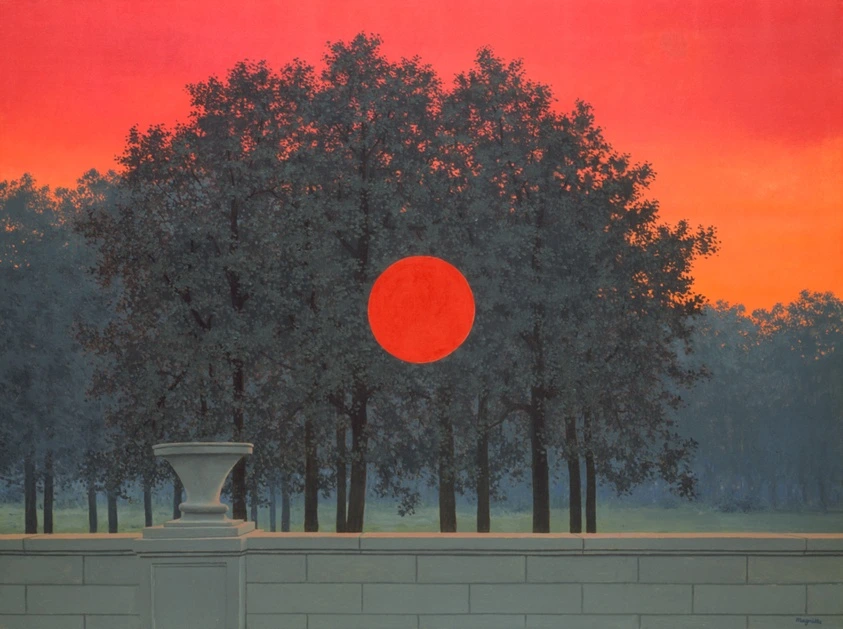
"Homesickness" is one of Magritte's most melancholic and enigmatic gouaches, executed around 1948 during the period when he was reestablishing his career after the war and producing the series of works that would consolidate his international reputation as the philosopher-painter of Surrealism. The composition shows a figure—probably a man in a bowler hat, Magritte's signature everyman—standing before a landscape that is simultaneously familiar and strange, the elements of the scene displaced and recombined to create an atmosphere of longing without a specific object. The watercolor and gouache technique creates a soft, atmospheric surface that makes the image feel like a memory or a dream, the touches of graphite suggesting the provisional, searching quality of the artist's process. The cream wove paper provides a warm, sympathetic ground that makes the pale colors appear to glow with an inner light, an effect that enhances the sense of emotional vulnerability. The 1948 date places this work in the period of Magritte's first major postwar exhibitions and his growing recognition in the United States, where his influence on the development of Pop Art and Conceptual Art would be profound. Art historians have connected this image to the broader tradition of the romantic landscape, from the wanderers of Friedrich to the flâneurs of Baudelaire, noting that Magritte's treatment is more psychologically abstract, less topographically specific than these predecessors. The work also reflects the personal circumstances of its creation: Magritte had spent the war years in Belgium, separated from the international art world, and the theme of homesickness may carry autobiographical weight, a longing for the prewar world of artistic community and intellectual exchange.
Cultural Impact
This c. 1948 gouache made postwar melancholy atmospheric through bowler-hat everyman landscape displacement, using cream-paper warmth and graphite searching to turn romantic wanderer tradition into psychological abstraction.
Why It Matters
It matters because Magritte painted a man missing a place that doesn't exist—proving that even homesickness could be beautiful if the sky was the wrong color.