Accession Number
113426
Medium
Watercolor over graphite (recto), and graphite (verso), on off-white wove paper
Dimensions
35.5 × 25.3 cm (14 × 10 in.)
Classification
watercolor
Credit Line
Alfred Stieglitz Collection
Background & Context
Background Story
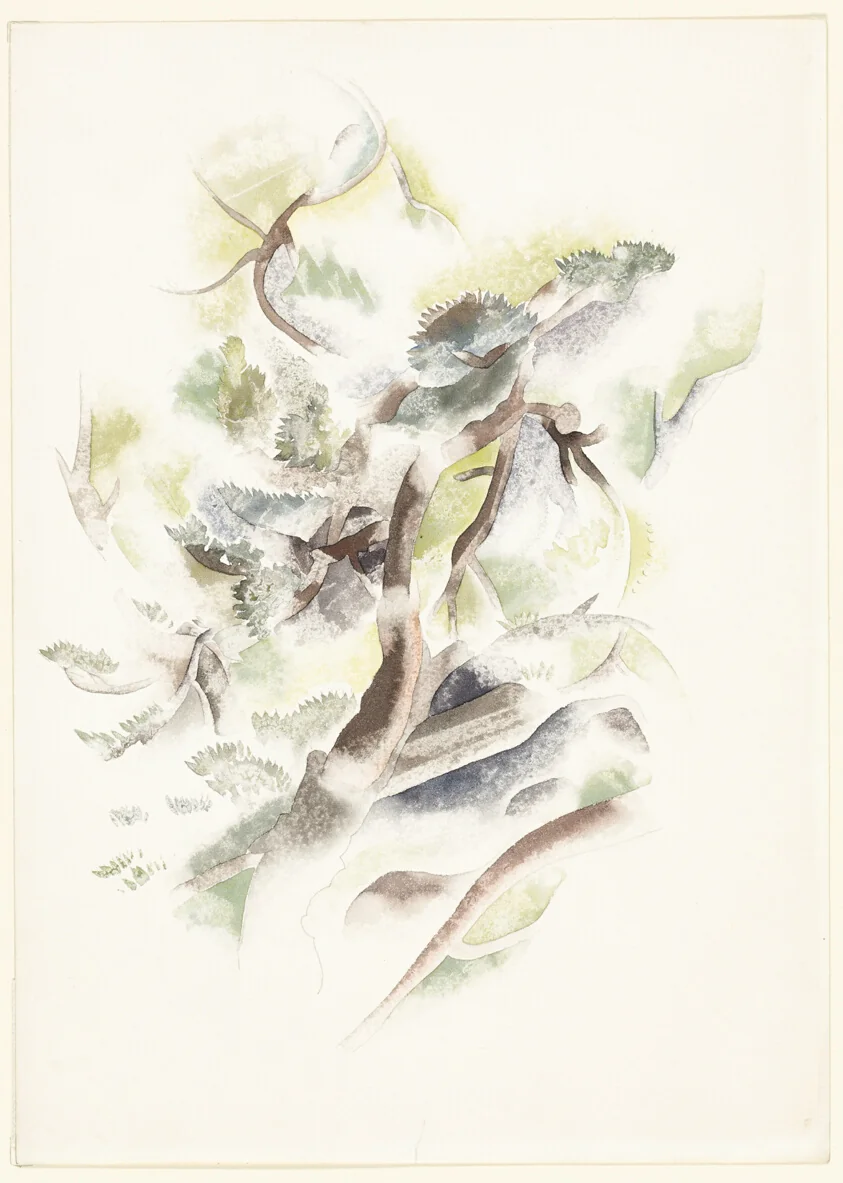
"Tree Forms No. 3" is a c. 1919 watercolor by Charles Demuth that captures the American Precisionist painter in his most abstract and formally inventive mode, the image showing tree forms rendered with the same crystalline precision and bold simplification that characterized his most powerful geometric compositions. The composition is a vertical watercolor—35.5 × 25.3 centimeters—showing trees reduced to their essential geometric forms with the watercolor over graphite on off-white wove paper creating a surface of extraordinary clarity and structural purity, the transparent washes suggesting both the physical reality of the tree and the abstract beauty of its underlying form. The off-white wove paper provides a cool, neutral ground that makes the watercolor colors appear crisp and luminous, enhancing the sense of geometric order and formal perfection. The c. 1919 date places this work in the period of Demuth's earliest engagement with the Precisionist aesthetic, when he was producing the watercolors that established his reputation as the leading American interpreter of Cubist abstraction and geometric simplification. Art historians have connected this watercolor to the broader tradition of the tree in modern art, from the Cubist landscapes of Braque to the precisionist works of the American modernists, noting that Demuth's treatment is more focused on the geometric abstraction and the structural clarity, the reduction of natural form to essential shapes and lines, than the naturalistic observation or the expressive distortion of these other traditions.
Cultural Impact
This c. 1919 watercolor made trees structurally pure through vertical 35cm crystalline geometric simplification and off-white paper crisp luminosity, using early Precisionist Cubist-influenced vocabulary to reduce natural form into essential shape-line clarity beyond Braque landscape fragmentation.
Why It Matters
It matters because Demuth painted a tree and made the paper feel like it was doing geometry—proving that even a forest could be a diagram if the watercolor was precise enough.