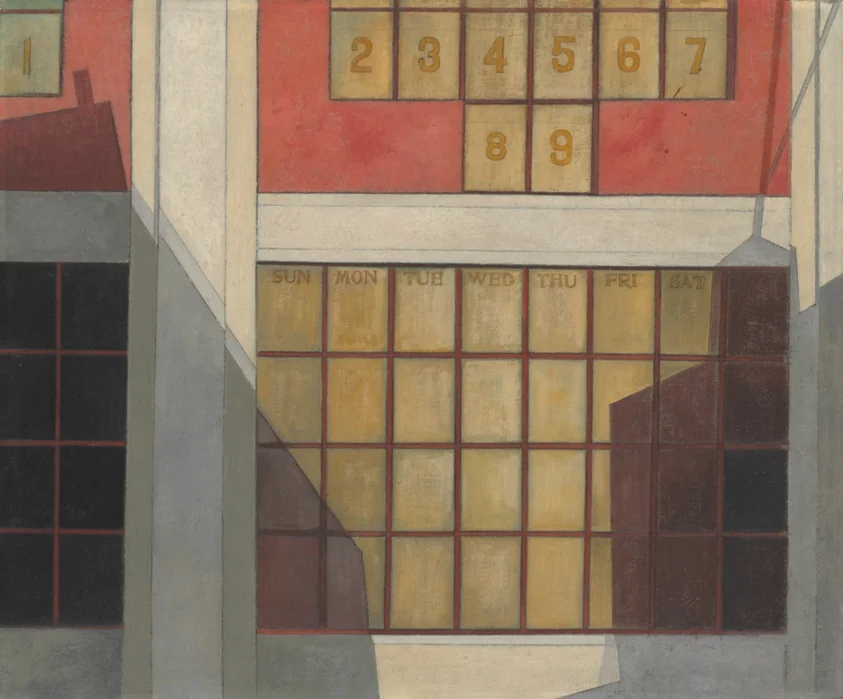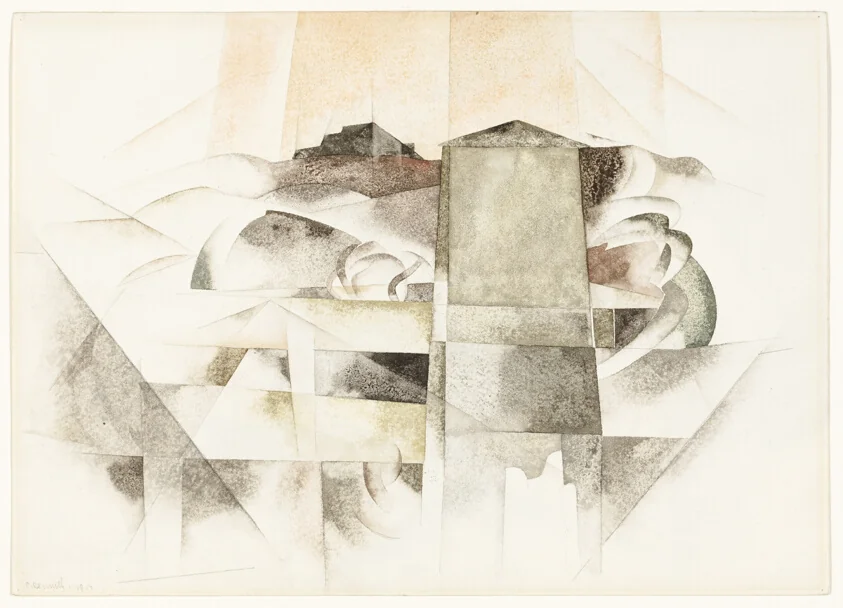
Bermuda No.3 - The Tower (recto); Landscape with House (verso)

Description

A native of Pennsylvania, Charles Demuth studied at the Drexel Institute of Art, Science, and Industry, and then the Pennsylvania Academy of the Fine Arts. In February 1917, he traveled with friend and fellow artist Mardsen Hartley to Bermuda, where he painted this watercolor. Here elements of Analytical Cubism intersect with the American Watercolor Revival’s emphasis on vibrant effects created by light passing through thin veils of color. While on a trip to Europe, the collectors Gertrude and Leo Stein introduced Demuth to the work of Paul Cézanne, Pablo Picasso, and Georges Braque; back in the United States, he developed a more restrained, evocative form of Cubism than his European contemporaries.

Bermuda No.3 - The Tower (recto); Landscape with House (verso)

Charles Demuth

1917

Accession Number

113424

Medium

Watercolor over graphite (recto and verso) on off-white wove paper

Dimensions

25.4 × 35.4 cm (10 × 13 15/16 in.)

Classification

watercolor

Museum

The Art Institute of Chicago

Chicago, United States

Credit Line

Alfred Stieglitz Collection

Background & Context

Background Story

Charles Demuths Bermuda No.3 - The Tower from 1917 captures the tropical architecture and lush vegetation of Bermuda with the geometric clarity and luminous color that define the artists finest watercolors. Demuth traveled to Bermuda in 1917 at the behest of his friend Marsden Hartley, who was also recovering from illness on the island, and the visit produced a series of watercolors that rank among the highest achievements of American modernist painting in the medium. The tower of the title, a Bermudian architectural feature with its distinctive white roof and pastel walls, rises through a tangle of foliage rendered in transparent washes that let the white paper function as both light source and structural element. Demuths watercolor technique is at its most precise here: washes are controlled with architectural exactness, edges are razor-sharp where they need to be and soft where atmosphere demands, and the white of the paper sings through every passage like sunlight through stained glass. The verso landscape, a more informal sketch of a house amidst trees, reveals a different register of the same seeing hand, looser and more spontaneous but no less attentive to the specific qualities of Bermudian light and form.

Cultural Impact

Demuths Bermuda watercolors of 1917 are among the finest works in the American watercolor tradition and a cornerstone of American modernism. They demonstrate that Precisionism, the movement with which Demuth is most associated, was not merely about industrial geometry but about finding structural clarity in any subject, from smokestacks to tropical vegetation.

Why It Matters

A luminous watercolor by Demuth from his Bermuda visit that combines tropical subject matter with Precisionist geometric clarity, ranking among the finest achievements of American modernist watercolor painting.