Accession Number
65850
Medium
Watercolor and graphite on off-white wove paper
Dimensions
35.5 × 25.4 cm (14 × 10 in.)
Classification
watercolor
Credit Line
Alfred Stieglitz Collection
Background & Context
Background Story
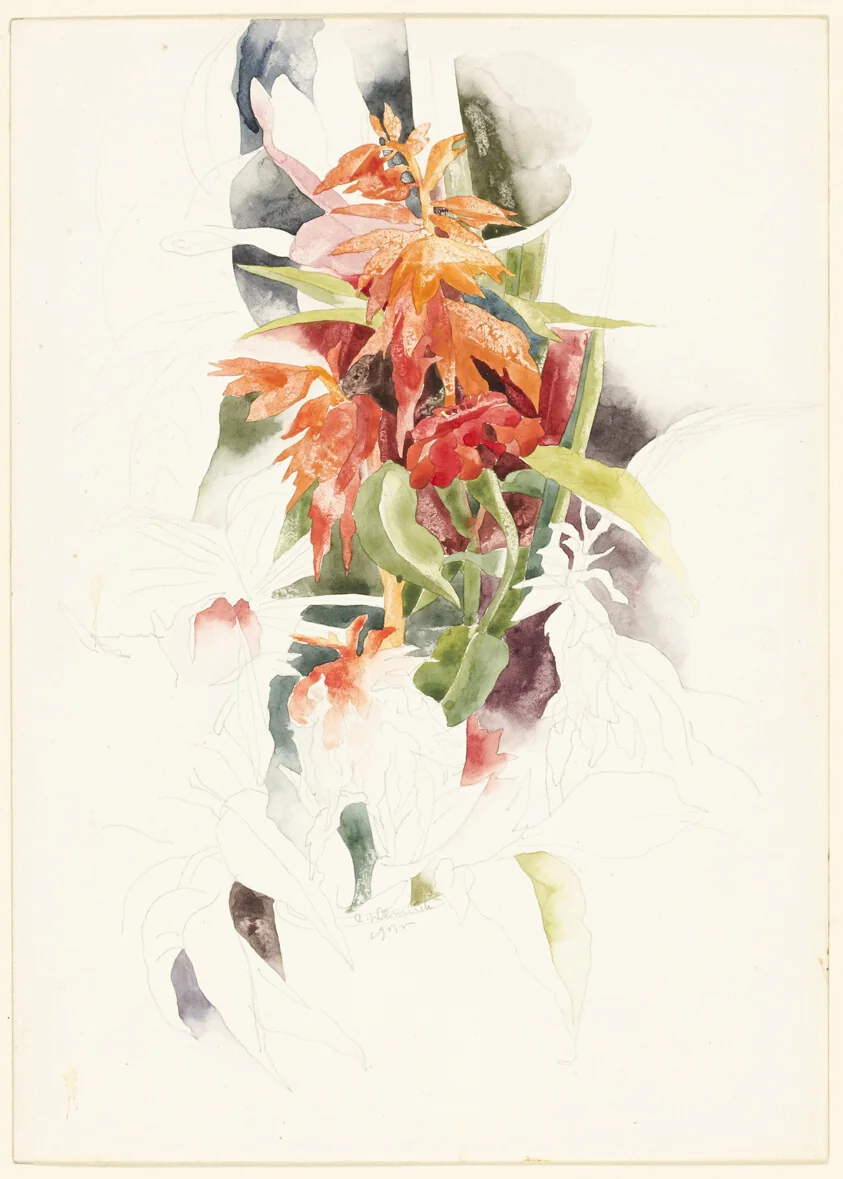
Charles Demuths Salvia and Zinnia from 1922 is a watercolor still life that transforms the humble subject of cut flowers in a vase into a composition of extraordinary formal sophistication and chromatic subtlety. Demuth was one of the supreme watercolorists in American art, and this late flower piece demonstrates the mastery he achieved in a medium he had been practicing since his student days at the Pennsylvania Academy. The salvia spires rise vertically through the composition like architectural elements, their linear structure contrasting with the rounded, almost exploding zinnia blooms that anchor the lower half of the image. Demuth builds the flowers through overlapping transparent washes, allowing each layer to dry before adding the next, so that the final color is a compound of multiple hues seen simultaneously through and across each other. The graphite underdrawing remains visible in places, contributing structural lines that organize the floral abundance without containing it. By 1922, Demuth was producing his first Precisionist industrial landscapes, and this floral watercolor reveals the same organizing intelligence: the flowers are not merely observed but composed, their natural forms disciplined into a pictorial architecture that anticipates the geometric structures of his factory paintings.
Cultural Impact
Demuths flower watercolours are among the most commercially successful and artistically influential works in the American watercolor tradition. They established a standard for the medium that influenced artists from Charles Burchfield to Andrew Wyeth, and their combination of botanical accuracy with modernist composition remains a model for the integration of observation and abstraction.
Why It Matters
A masterful watercolor still life by Demuth that transforms salvia and zinnia into a composition of architectural precision and chromatic subtlety, revealing the Precisionist sensibility that underlies even his most botanical subjects.