Accession Number
118691
Medium
Oil on linen
Dimensions
58.4 × 73 cm (23 1/2 × 28 3/4 in.)
Classification
Painting
Credit Line
Lindy and Edwin Bergman Collection
Background & Context
Background Story
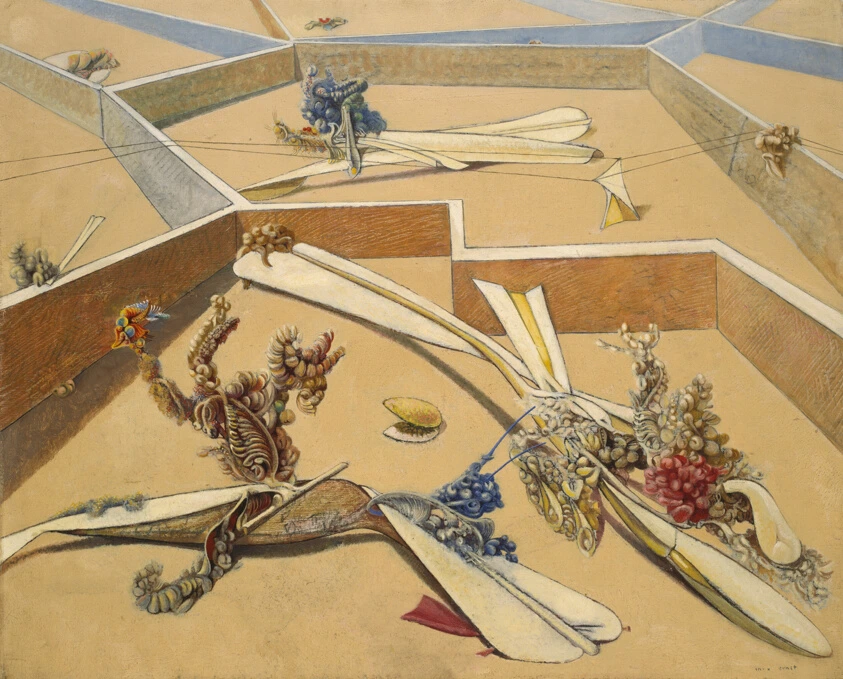
Max Ernst (1891-1976) was a German painter known as one of the founders of the Dada movement and one of the most important painters of the Surrealist movement, whose inventive, dreamlike paintings make him one of the most important artists of the 20th century. Garden Airplane-Trap from 1935 depicts a garden with an airplane in the inventive, dreamlike manner that distinguishes Ernst's best Surrealist work from the more straightforward painting of his contemporaries. The 1935 date places this in Ernst's most productive Surrealist period, when he was producing the inventive, dreamlike paintings that are his most accomplished works, and the garden-airplane combination shows his talent for combining natural and mechanical elements in surreal juxtapositions.
Cultural Impact
Garden Airplane-Trap is important in the history of Surrealism because it demonstrates the inventive, dreamlike manner that Ernst brought to painting as one of the most important painters of the Surrealist movement. Ernst's inventive juxtapositions—combining natural and mechanical elements in dreamlike combinations that challenge the viewer's expectations—represent one of the most important developments in 20th-century art, and the 1935 painting shows this development at its most inventive.
Why It Matters
Garden Airplane-Trap is Ernst's inventive Surrealism: a garden with an airplane rendered in the dreamlike manner of one of the most important painters of the Surrealist movement. The 1935 painting shows Ernst's most distinctive contribution—the surreal juxtaposition of natural and mechanical elements that challenges the viewer's expectations.