Provenance
Sold by the Bodley Gallery, New York, Lindy and Edwin Bergman, Chicago, 1960; given to the Art Institute of Chicago, 2018.
Accession Number
118688
Medium
Collage composed of printed, cut elements, with touches of watercolor, laid down on cream wove paper
Dimensions
23.9 × 16.7 cm (9 7/16 × 6 5/8 in.)
Classification
collage
Credit Line
Lindy and Edwin Bergman Collection
Background & Context
Background Story
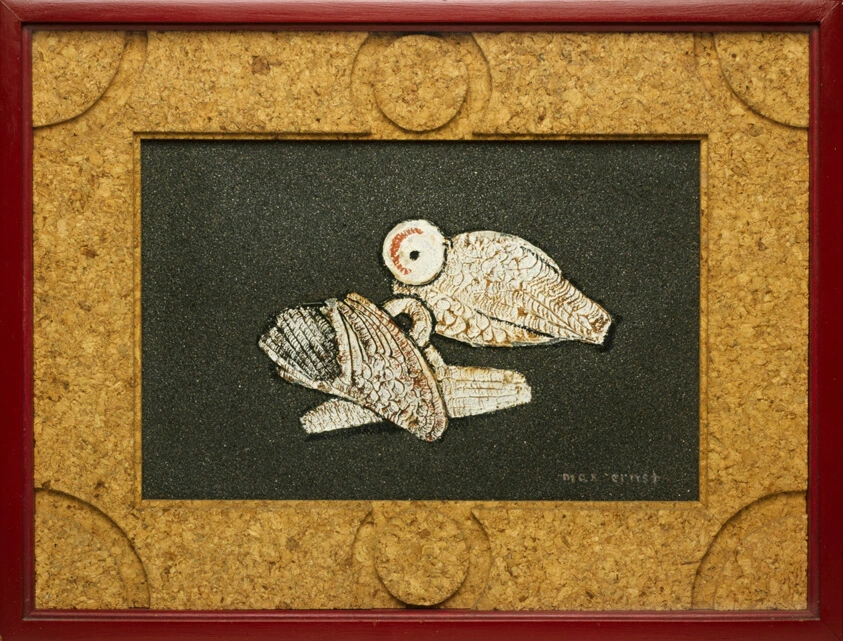
"Marceline and Marie" is a 1929–30 collage that exemplifies Max Ernst's "overpainting" technique, in which printed elements from commercial catalogues and scientific illustrations are cut, rearranged, and modified with watercolor to create uncanny new images. The figures of Marceline and Marie emerge from Ernst's personal mythology: they are probably amalgams of his wives and lovers, transformed into hybrid creatures that combine human, mechanical, and botanical features. The collage technique itself carries Surrealist theory: by forcing unrelated images into proximity, the artist bypasses rational control and taps into the unconscious associations that André Breton called "convulsive beauty." Ernst's source materials for this period included nineteenth-century encyclopedias, natural history plates, and fashion magazines, all of which provided the raw material for his alchemical transformations. The watercolor additions are subtle—washes that blend the printed elements into a unified atmospheric ground, suggesting that these impossible figures occupy real space. The work also reflects Ernst's success in 1930s Paris: he was no longer the struggling Dadaist of the postwar years but a recognized Surrealist master who could command high prices for his collages. Yet the content remained disturbing, suggesting that commercial success had not tamed the darker currents of his imagination. Art historians have compared these late collages to the contemporary photography of Man Ray and Maurice Tabard, which similarly exploited doubling and transformation. The intimate scale of the work—barely 24 × 17 centimeters—makes it a private object, almost a diary entry in visual form.
Cultural Impact
This late collage demonstrated Surrealist convulsive beauty through overpainting, transforming commercial prints into private mythological figures that merged human anatomy with mechanical and botanical fantasy.
Why It Matters
It matters because Ernst made his lovers into collages—cutting them out of catalogs and pasting them back together as something stranger than memory.