Provenance
Possibly E. Kleinmann, Paris. Rene Grenier, Paris. Henri Cottereau, Paris. Carter H. Harrison (1860-1953), Chicago, by 1931 [New York 1931]; given to the Art Institute, 1933
Accession Number
15773
Medium
Charcoal, heightened with white chalk, with stumping and erasing, on blue wove paper
Dimensions
34.4 × 46.2 cm (13 9/16 × 18 1/4 in.)
Classification
charcoal
Credit Line
Mr. and Mrs. Carter H. Harrison Collection
Background & Context
Background Story
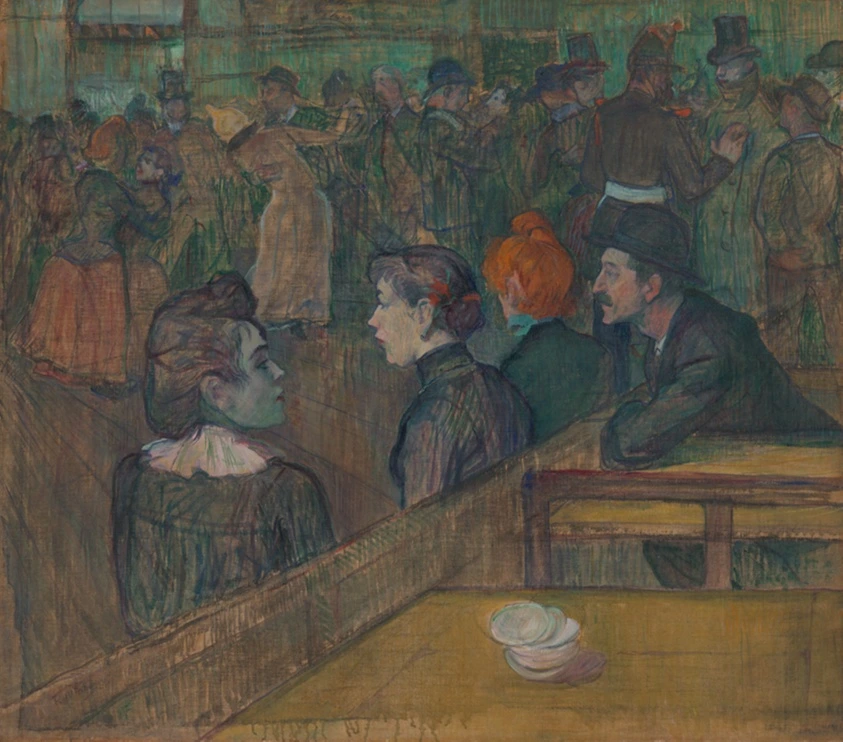
Henri de Toulouse-Lautrec's "Bar of the Café of the rue de Rome" (c. 1886) is a charcoal drawing heightened with white chalk, with stumping and erasing on blue wove paper. This early work from 1886, when Lautrec was 22, shows the interior of a café—a subject that would dominate his art. The café bar, with its counter, bottles, and patrons, was a quintessential subject of modern life. Lautrec's treatment captures the atmosphere of the café: the lighting, the social interactions, the casual elegance of the Parisian interior. The charcoal technique on blue paper is effective: the blue provides a cool mid-tone, the charcoal builds the dark forms, and the white chalk picks out the highlights. The stumping creates soft transitions of tone. The erasing adds lighter areas by removing charcoal. This early work already displays the qualities that would define Lautrec's mature style: the sharp eye for character, the economical draftsmanship, and the ability to capture the essence of a scene with remarkable economy.
Cultural Impact
Toulouse-Lautrec's café scenes document the social life of late 19th-century Paris, capturing the atmosphere of the city's legendary bohemian culture with unmatched vividness and authenticity.
Why It Matters
This early drawing of a café bar captures the atmosphere of Parisian social life with remarkable economy, the charcoal and white chalk on blue paper creating a vivid sense of the interior's light and character.