Accession Number
110993
Medium
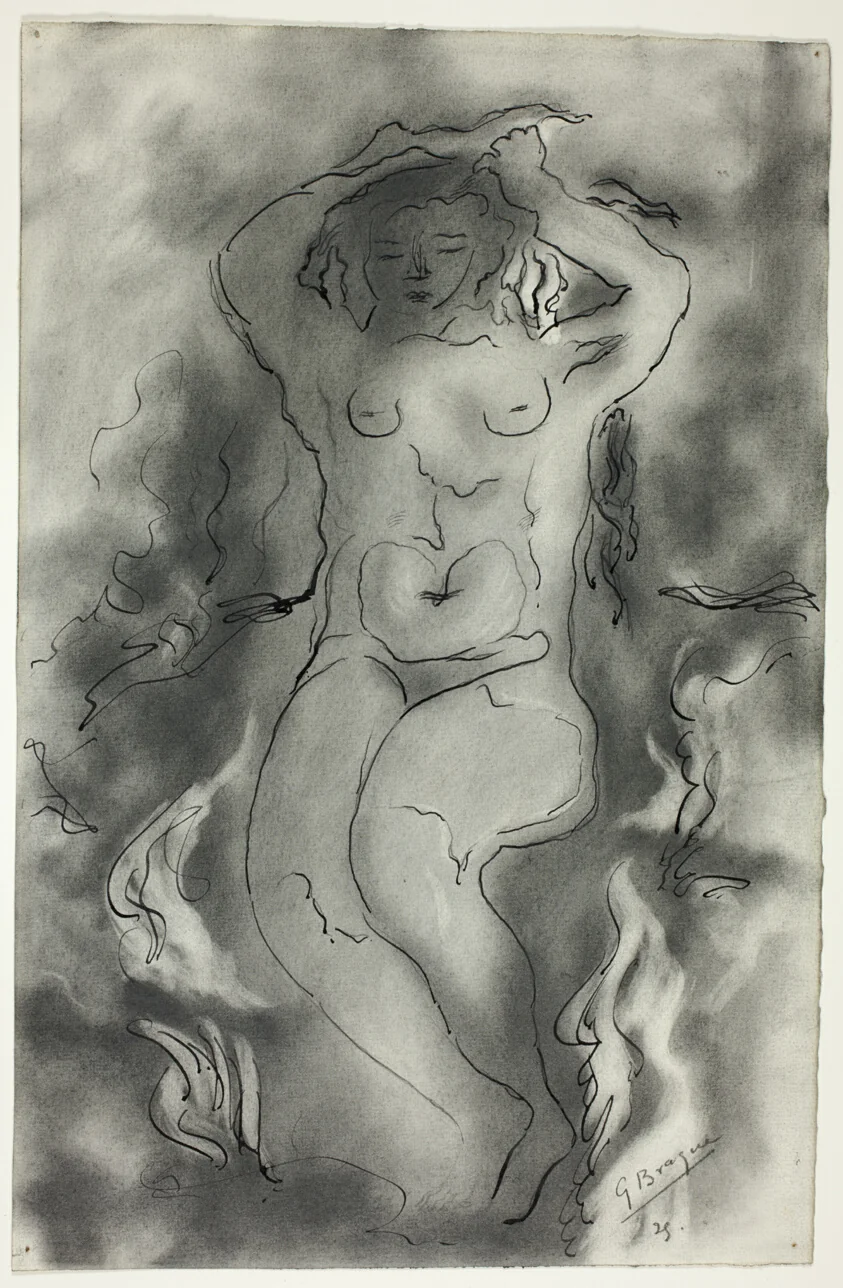
Pen and black ink, with stumped charcoal, with erasing (recto), and pen and black ink over charcoal and graphite, with stumping and erasing (verso), over graphite on white wove paper.
Dimensions
41.1 × 26.7 cm (16 3/16 × 10 9/16 in.)
Classification
pen and ink drawings
Credit Line
Gift of Mary and Leigh Block
Background & Context
Background Story
Georges Braque's double-sided "Nude" (1929) is a pen and black ink drawing on white wove paper, with charcoal on the recto and pen over charcoal and graphite on the verso. Braque (1882–1963) was co-inventor of Cubism with Picasso, and his later work evolved toward a more personal, sensuous style that remained indebted to Cubist principles while incorporating new concerns with color, texture, and the human figure. This double-sided sheet of nude studies shows Braque's continuing engagement with the human form. The recto features a standing or seated nude, the figure rendered with the bold, simplified lines that characterize Braque's draftsmanship. The charcoal provides soft tonal areas, while the pen and ink create decisive contours. The verso shows a reclining nude in pen and ink over charcoal. The combination of media and the double-sided format makes this sheet particularly valuable for understanding Braque's working process. By 1929, Braque had moved beyond the analytical phase of Cubism into a more synthetic, decorative style that was entirely his own.
Cultural Impact
Braque's drawings of the human figure demonstrate the range of his draftsmanship and his lifelong commitment to the representation of the body, even as his style evolved from Cubist analysis to a more personal synthesis.
Why It Matters
This double-sided sheet of nude studies reveals Braque's mastery of line and form, the bold contours and soft charcoal creating a vivid sense of the body's volume and presence.


