Provenance
Madame Grenier, Paris. Henri Cottereau, Paris; Carter H. Harrison (1860-1953), Chicago, by 1927 [Joyant 1927]; given to the Art Institute, 1935.
Accession Number
113101
Medium
Oil paint, with graphite (recto), and oil paint with touches of black crayon varnished overall (verso), on gray cardboard
Dimensions
44.7 × 32.7 cm (17 5/8 × 12 7/8 in.)
Classification
oil paintings (visual works)
Credit Line
Mr. and Mrs. Carter H. Harrison Collection
Background & Context
Background Story
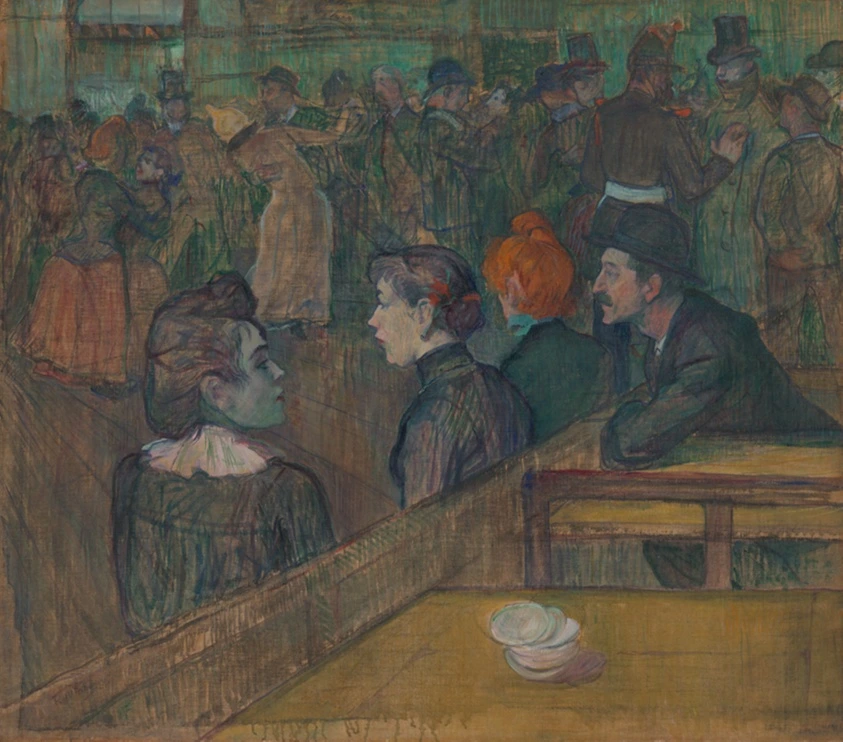
Henri de Toulouse-Lautrec's double-sided "Mme Lili Grenier (recto); Landscape with Church (verso)" (1885/88) is an oil painting with graphite on gray cardboard, with oil paint and black crayon on the verso. Mme Lili Grenier was a performer and the proprietor of a popular café in Paris. Lautrec's portrait of her on the recto captures her distinctive features with the directness and economy that characterize his best portraits. The gray cardboard provides a neutral ground, the oil paint applied in rapid strokes that suggest the forms without excessive detail. The verso shows a landscape with a church, perhaps a sketch from one of Lautrec's travels in the French countryside. The double-sided nature of this work is particularly valuable, showing the artist moving between the urban world of performers and the rural landscape on a single support. The contrast between the two sides—the sophisticated Parisian woman and the simple country church—reflects the range of Lautrec's experience and his ability to capture both worlds with equal skill.
Cultural Impact
Toulouse-Lautrec's portraits of performers and café proprietors provide a vivid record of the personalities who populated the entertainment world of fin-de-siècle Paris.
Why It Matters
This double-sided work captures the range of Lautrec's art: the portrait of a Parisian performer on one side and a quiet landscape on the other, both rendered with the same directness and economy.