Provenance
Estate of the artist, from 1903 [stamp, recto lower right, in blue ink; Lugt Supp. 613c]. Given by Sam Salz, New York, to the Art Institute, 1951.
Accession Number
75011
Medium
Black chalk on blue laid paper
Dimensions
31.8 × 47.8 cm (12 9/16 × 18 7/8 in.)
Classification
chalk
Credit Line
Gift of Sam Salz
Background & Context
Background Story
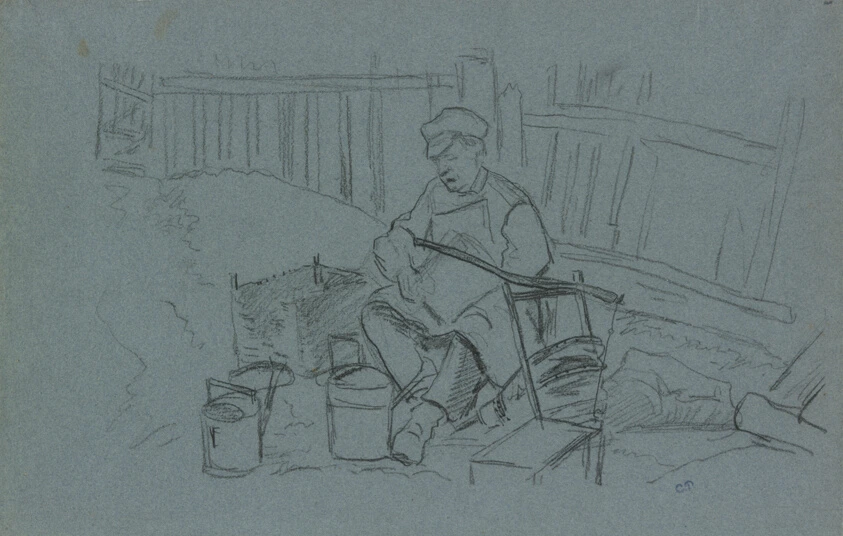
Camille Pissarro's "Tinker with His Tools" (1874/76) is a black chalk drawing on blue laid paper depicting an itinerant tinker—a craftsman who repaired pots, pans, and other metal household items. Blue laid paper was a favorite support for many 19th-century artists, providing a cool mid-tone against which both dark chalk and white highlights could be effectively used. Pissarro's drawing is economical but expressive: the tinker is shown with his characteristic tools, the figure rendered with a few confident strokes that capture his posture and profession. This drawing belongs to Pissarro's series of studies of rural workers and tradespeople, documenting the traditional occupations that were rapidly disappearing in the face of industrialization. As an anarchist, Pissarro believed in the value of artisanal work and the dignity of craftspeople, and his drawings of workers are never condescending. The tinker, a traveling craftsman who brought his skills from village to village, was a figure of independence and self-reliance that Pissarro admired.
Cultural Impact
Pissarro's drawings of rural tradespeople provide a valuable documentary record of traditional occupations that were disappearing in the late 19th century, preserved through the artist's sympathetic observation.
Why It Matters
This chalk drawing of a tinker captures the dignity of a traveling craftsman, the economical line and blue paper creating a portrait of a vanishing way of life that Pissarro respected and admired.


