Provenance
Sold, Hôtel Drouot, Paris, February 23, 1910, lot 262. V. S.; sold, Hôtel Drouot, Paris, May 6, 1953, lot 185, to de Bayser [according to Dortu 1971]. Wertheimer [according to Dortu 1971]. Mr. and Mrs. Kirk Askew [according to Dortu 1971]. Sold by Durlacher Brothers to the Art Institute, 1959.
Accession Number
9747
Medium
Black and blue crayon on tan wove paper
Dimensions
44.4 × 32.8 cm (17 1/2 × 12 15/16 in.)
Classification
crayon
Credit Line
Worcester Sketch Fund
Background & Context
Background Story
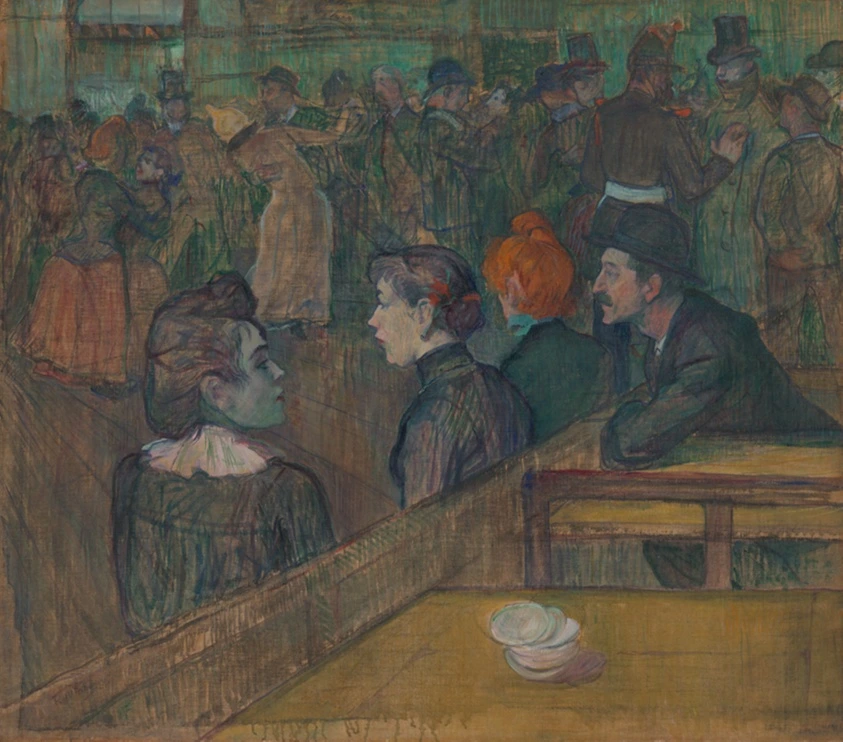
Henri de Toulouse-Lautrec's "The Cortege of the Rajah" (c. 1895) is a black and blue crayon drawing on tan wove paper that depicts an exotic procession. The title suggests a scene from the world of popular entertainment—perhaps a theatrical performance, a circus act, or a music-hall tableau representing the splendor of an Eastern potentate's retinue. Such exotic spectacles were popular in late 19th-century Paris, and Lautrec, as the chronicler of Montmartre entertainment, captured them with his characteristic wit and economy. The black and blue crayons create a simple but effective color scheme, the blue adding a note of color to the primarily black drawing. The tan wove paper provides a warm ground. The composition likely shows a procession of figures in elaborate costumes, their exoticism rendered with Lautrec's sharp eye for character and his gift for capturing movement and spectacle. This drawing belongs to the period when Lautrec was at the height of his fame, producing posters and prints that defined the visual culture of fin-de-siècle Paris.
Cultural Impact
Lautrec's drawings of theatrical and exotic spectacles document the popular entertainment of fin-de-siècle Paris, capturing the city's appetite for spectacle and exoticism with characteristic wit and verve.
Why It Matters
This drawing of an exotic procession captures the theatrical spectacle of Parisian entertainment, the black and blue crayons creating a vivid sense of movement and pageantry.