A Reasonable Facsimile

Description

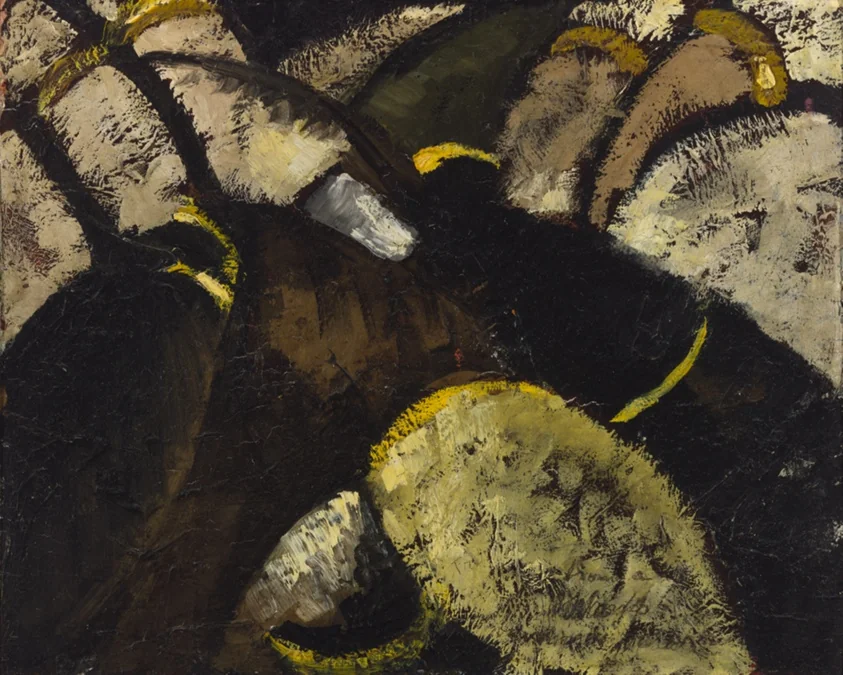
An exploration of the tensions between representation and abstraction, A Reasonable Facsimile appears purely nonobjective yet nevertheless suggests a landscape. The yellow half-circle at the top could represent the sun, one of Dove’s favorite subjects, and the areas of green and brown may be the earth below. When he exhibited this work in 1942 at An American Place, Dove published a poem in the catalogue, which includes the lines “There is much to be done— / Works of nature are abstract. / They do not lean on other things for meanings.” The title of this painting sums up Dove’s artistic project over the four decades of his career: to capture the abstraction of nature by creating “a reasonable facsimile” of its appearance.

A Reasonable Facsimile

Arthur Dove

1942

Accession Number

65906

Medium

Encaustic on canvas

Dimensions

47.3 × 63.2 cm (18 5/8 × 24 7/8 in.)

Classification

Painting

Museum

The Art Institute of Chicago

Chicago, United States

Credit Line

Alfred Stieglitz Collection
Background & Context

Background Story

Arthur Dove's "A Reasonable Facsimile" (1942) is an encaustic painting on canvas from late in the artist's career. Encaustic—a technique using pigmented wax—was unusual for Dove and for American painting in general, but it suited his interest in surface texture and materiality. The title "A Reasonable Facsimile" is intriguingly ambiguous: it might refer to the painting's relationship to nature (a "facsimile" of a natural subject), or it might be ironic (suggesting that the painting is only a reasonable copy of something larger and more significant). By 1942, Dove had developed a fully mature abstract style, and this work shows his continued exploration of organic forms and natural rhythms. The encaustic medium allows for a rich, varied surface, with the wax holding the brushstrokes and tool marks with particular clarity. The palette is likely warm and earthy, reflecting Dove's continued engagement with the colors and forms of the natural world around his Long Island home.

Cultural Impact

Dove's late works, including his experiments with encaustic, show the continuing evolution of America's first abstract painter, adapting new techniques to his established vision.

Why It Matters

This late encaustic painting shows Dove still experimenting in his sixties, the title's ironic self-awareness adding a layer of intellectual play to the abstract composition.