Champs de Mars: The Red Tower

Description

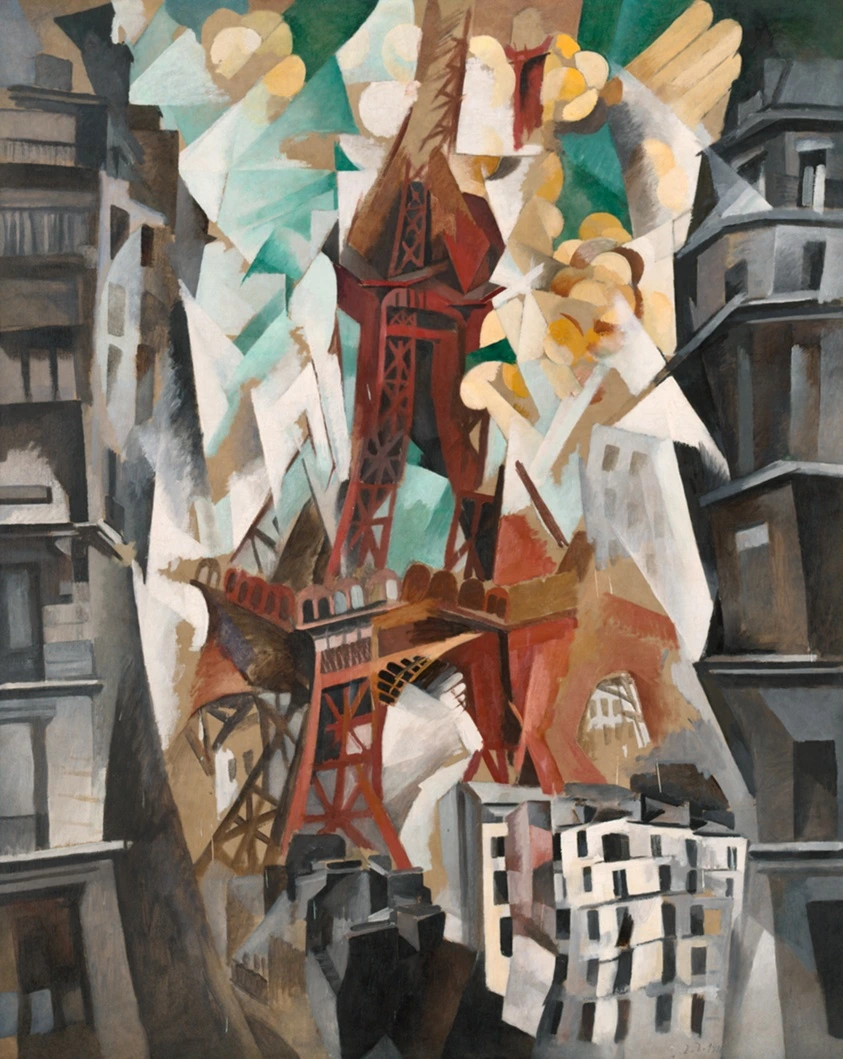
Robert Delaunay was four years old when the Eiffel Tower was erected in Paris in the public green space known as the Champ de Mars. One of many artists to depict the landmark, Delaunay did a series of Eiffel Tower paintings, of which the Art Institute’s example is among the best known. The artist infused the dynamism of modern life into this image by employing multiple viewpoints, rhythmic fragmentation of form, and strong color contrasts. Delaunay accented the structure’s towering presence by framing it with tall buildings and placing smaller, shorter buildings, seen from above, at its base. The top of the tower seems to soar, its massive structure augmented by winglike clouds and patches of light-filled sky.

The artist first showed this painting in the winter of 1912, at the Galerie Barbazanges in Paris, where Guillaume Apollinaire described the work in a review as “unfinished, whether by design or accident.” Although Delaunay’s intent is not recorded, it is certain that by 1923, when this work was illustrated in the pages of the Bulletin de l’effort modern, it looked as it does today: the artist had repainted portions of the canvas and filled areas of reserve with paint.

This is one of thirty-five works that comprise the Winterbotham Collection. Click here to learn more about the collection.

Provenance

The artist; sold through Galerie L’Effort Moderne, Paris, to Tarsila do Amaral (1886–1973), Paris and São Paolo, Brazil, 1923 [this and the following according to letter from Aracy A. Amaral, July 15, 1975, in curatorial file]; sold to the Galerie Michel Couturier, Paris, c. 1952. Sold through Justin K. Thannhauser, New York, to the Art Institute, 1959.

Champs de Mars: The Red Tower

Robert Delaunay

1911/23

Accession Number

9503

Medium

Oil on canvas

Dimensions

160.7 × 128.6 cm (63 1/4 × 50 5/8 in.)

Classification

Painting

Museum

The Art Institute of Chicago

Chicago, United States

Credit Line

Joseph Winterbotham Collection

Background & Context

Background Story

Robert Delaunay (1885-1941) painted Champs de Mars: The Red Tower in 1911 and reworked it in 1923, creating one of his most important paintings of the Eiffel Tower—the subject that he returned to throughout his career as the symbol of modern Paris. The painting depicts the Eiffel Tower viewed from the Champs de Mars in the fragmented, colorful manner that Delaunay was developing in 1911 as his contribution to Cubism—a manner that he and his wife Sonia Delaunay would later call Simultanism. The 1911/23 dates reflect the two phases of the painting: the initial Cubist fragmentation of 1911 and the Simultanist color that Delaunay added when he reworked the painting in 1923.

Cultural Impact

Champs de Mars: The Red Tower is important in the history of Cubism because it demonstrates the colorful, fragmented manner that Delaunay was developing as his contribution to the movement—a manner that differed from the monochrome analytical Cubism of Picasso and Braque in its emphasis on color and light. Delaunay's Eiffel Tower paintings represent an alternative to analytical Cubism that emphasizes color and light over the analysis of form, and Champs de Mars: The Red Tower shows this alternative at its most accomplished.

Why It Matters

Champs de Mars: The Red Tower is Delaunay's colorful alternative to analytical Cubism: the Eiffel Tower fragmented and colored in the Simultanist manner that he was developing in 1911. The 1911/23 painting represents the colorful, light-filled alternative to the monochrome analytical Cubism of Picasso and Braque, with the Eiffel Tower as the symbol of modern Paris.