Virgin and Child

Description

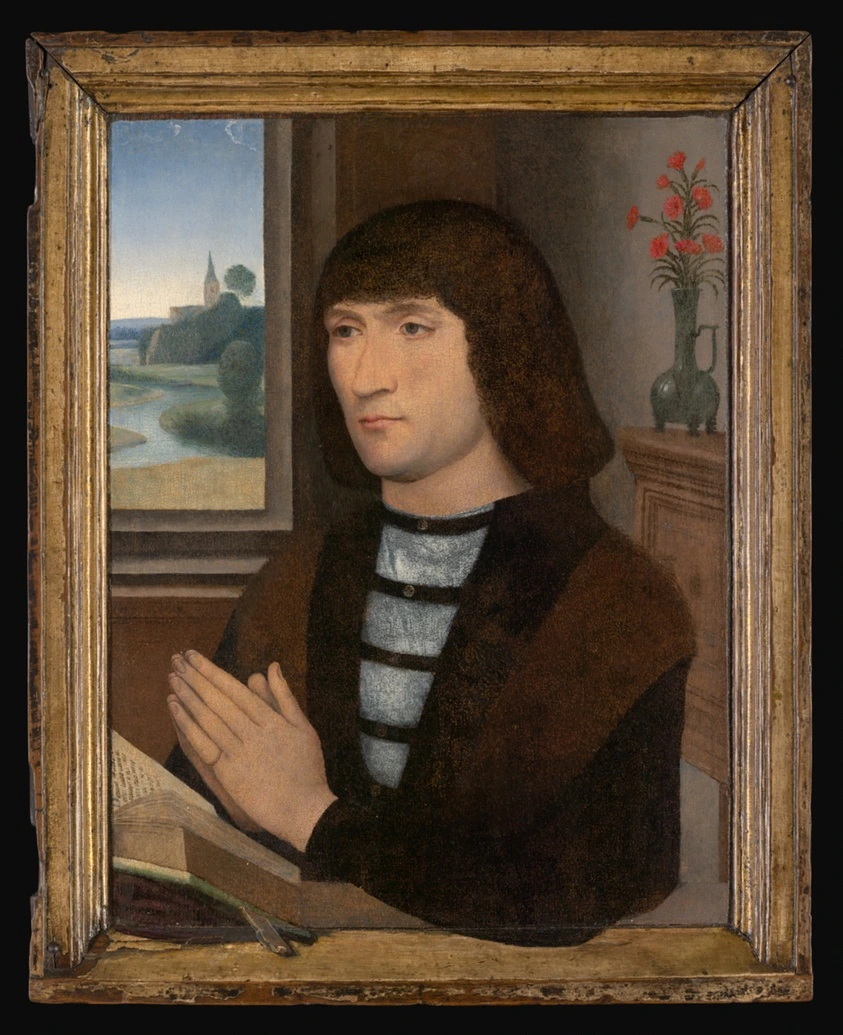
This panel and a portrait of a man in prayer once hinged together to form a diptych, with the Virgin and Child on the left and the portrait of a man facing her on the right. The condition of the portrait is very poor, while its reverse—featuring an image of Saint Anthony of Padua—is well preserved. It is painted in grisaille, a technique that mimics sculpture through monochromatic shades of beige and gray. This outer panel would have been visible when the diptych was closed and served as a transition point between the earthly setting outside the diptych into the sacred space within, painted in colorful, lavish detail. Visual cues like Anthony’s sandaled toe stepping on the edge of the frame and the reflection of two children—perhaps the donor’s—in the convex mirror behind the Virgin reinforce the paintings’ role as an intermediary meeting point reached through prayer.

Provenance

Probably a Spanish convent [according to invoice from Steinmeyer, Paris, June 23, 1913 in curatorial file]. Private collection, Spain, by 1892 [according to Hymans 1894, p. 159, it was lent to the 1892–93 Madrid exhibition by a private owner]. Steinmeyer & Fils, Paris, 1913; sold to Martin A. Ryerson (d. 1932), Chicago, June 23, 1913 [invoice cited above]; on loan to the Art Institute by 1915; bequeathed to the Art Institute, 1933.

Virgin and Child

Hans Memling

c. 1485

Accession Number

16295

Medium

Oil on panel

Dimensions

Framed: 41.1 × 33.4 cm (16 3/16 × 13 1/8 in.)

Classification

oil on panel

Museum

The Art Institute of Chicago

Chicago, United States

Credit Line

Mr. and Mrs. Martin A. Ryerson Collection

Background & Context

Background Story

Hans Memling's "Virgin and Child" (c. 1485) is an oil on panel from the late 15th century, depicting the Virgin Mary holding the Christ Child. Memling (c. 1430–1494) was one of the greatest painters of the early Netherlandish school, working in Bruges and producing altarpieces, devotional paintings, and portraits of exquisite refinement. This Virgin and Child shows Mary enthroned, perhaps in a garden or a domestic interior, holding the infant Jesus on her lap. The painting is executed in oil on panel, the medium that allowed Netherlandish painters to achieve extraordinary richness of color and precision of detail. Memling's technique is characterized by luminous colors, meticulous detail, and a serene, idealized beauty that distinguishes his work from the more austere style of earlier Netherlandish painters. The Virgin is shown with her traditional attributes—perhaps a blue robe, a crown, or a book—while the Christ Child reaches out to bless the viewer or to accept a flower. The background may include a landscape view or a gold ground, situating the scene in a timeless, sacred space.

Cultural Impact

Memling's Virgins and Childs represent the highest achievement of early Netherlandish devotional painting, combining exquisite technical refinement with a serene, spiritual beauty that has moved viewers for over five centuries.

Why It Matters

This Virgin and Child captures the serene beauty and spiritual grace of Memling's art, the luminous colors and meticulous detail creating an image of divine love and human tenderness.