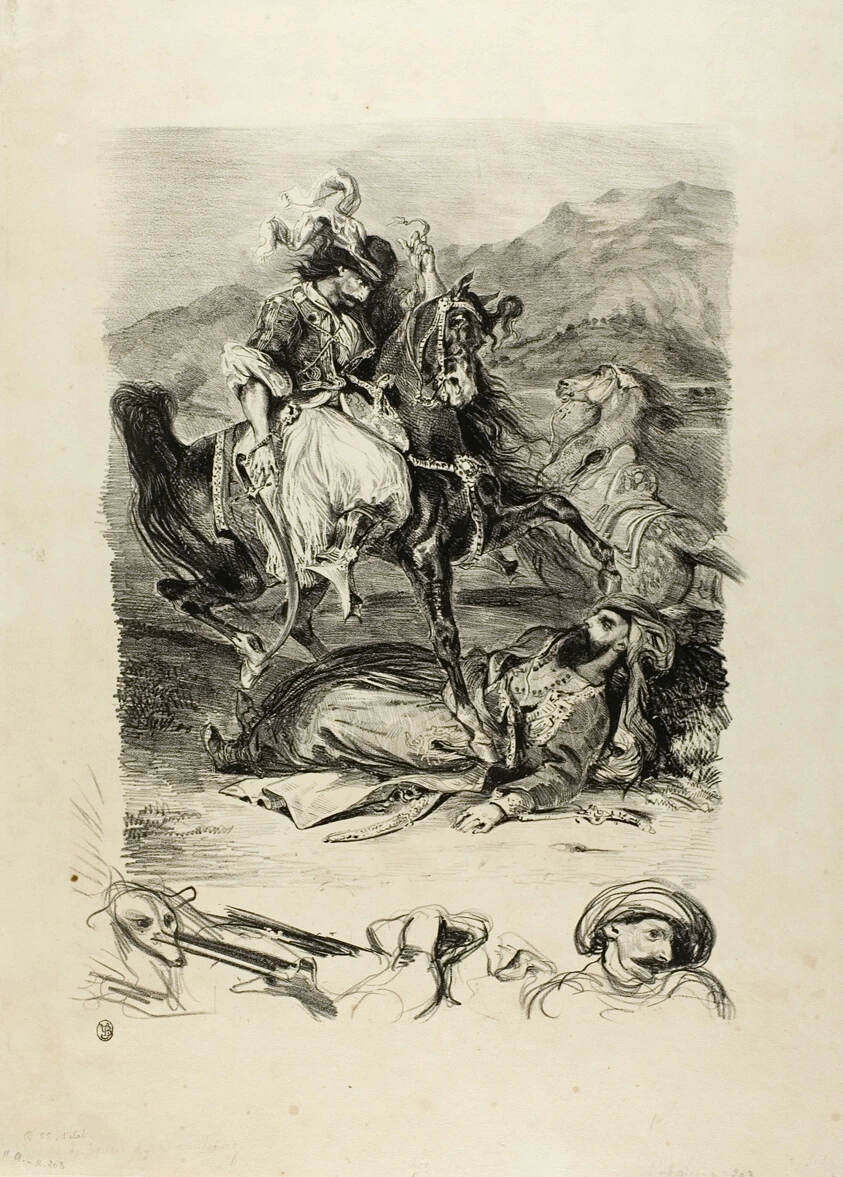
The Combat of the Giaour and Hassan

Description

This colorful scene was inspired by a poem from Lord Byron’s “Oriental tales,” a popular series of romances. Both the poem and the painting are examples of 19th-century Europeans’ interest in fantastical and often violent depictions of Middle Eastern, North African, and Asian cultures, which reinforced colonialist aims. Although Eugène Delacroix did not visit North Africa until 1832, he began painting Orientalist subjects early on in his career. The artist’s French audience would have been receptive to his choice of jewel-like colors to describe the shimmering, gold-braided vest and billowing robes of the central figures. Far from accurately representing the attire of the 17th-century combatants of Byron’s poem, Delacroix drew upon styles worn by the Turko-Egyptian Mameluke warriors during Napoleon Bonaparte’s military campaign in Egypt in 1798–99.

The Combat of the Giaour and Hassan

Eugène Delacroix

1826

Accession Number

110663

Medium

Oil on canvas

Dimensions

59.6 × 73.4 cm (23 1/2 × 28 7/8 in.); Framed: 87.4 × 101.3 cm (34 3/8 × 39 7/8 in.)

Classification

oil on canvas

Museum

The Art Institute of Chicago

Chicago, United States

Credit Line

Gift of Bertha Palmer Thorne, Rose Movius Palmer, Mr. and Mrs. Arthur M. Wood, and Mr. and Mrs. Gordon Palmer

Background & Context

Background Story

Eugène Delacroix's "The Combat of the Giaour and Hassan" (1826) is an oil on canvas based on Lord Byron's poem "The Giaour," one of the most popular works of Romantic literature. Byron's poem, set in Greece under Ottoman rule, tells the story of a Venetian (the Giaour) who kills the Turkish pasha Hassan in revenge for the death of his beloved. Delacroix was deeply drawn to Byron's work, finding in it the passion, exoticism, and violence that matched his own Romantic sensibility. This painting shows the climactic combat between the Giaour and Hassan, the figures locked in mortal struggle. The composition is dynamic and compressed, the energy of the fight conveyed through the twisting bodies and the dramatic play of light and shadow. The palette is rich and intense, with the deep reds, blacks, and golds that characterize Delacroix's Romantic style. This painting was created at the height of Delacroix's early career, just after the triumph of "The Massacre at Chios" at the 1824 Salon, and it shows the artist at his most confident and ambitious.

Cultural Impact

Delacroix's Byron-inspired paintings were central to the Romantic movement's engagement with literature, demonstrating the power of painting to match the emotional intensity and exotic vision of Romantic poetry.

Why It Matters

This painting of the combat between the Giaour and Hassan captures the essence of Romanticism: passion, violence, exoticism, and the struggle between opposing forces, rendered with Delacroix's characteristic dramatic intensity.