Accession Number
9148
Medium
Oil on plaster, transferred to canvas
Dimensions
153.5 × 152.5 cm (60 3/8 × 60 in.); Framed: 167.7 × 167.7 cm (66 × 66 in.)
Classification
Painting
Credit Line
Helen Birch Bartlett Memorial Collection
Background & Context
Background Story
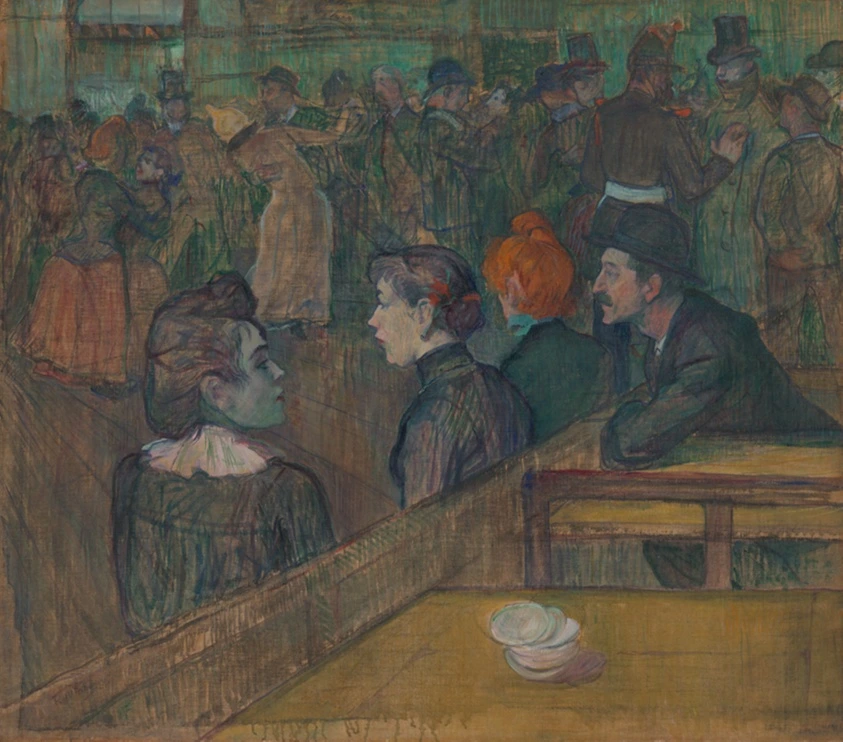
"Ballet Dancers" is one of Toulouse-Lautrec's most monumental early paintings, executed in 1885–86 in oil on plaster and later transferred to canvas, a work that documents his formative engagement with the Paris Opéra and the world of professional dance that would provide the subjects for his most famous posters and prints. The composition shows a group of dancers in rehearsal or performance, their bodies arranged in a frieze-like composition that recalls Degas's ballet scenes while anticipating the graphic flatness of Toulouse-Lautrec's mature style. The scale is imposing—153.5 × 152.5 centimeters—placing this among the artist's largest early works and suggesting that he intended to make a public statement about his ambitions. The palette is warm and earthy, the dancers' flesh tones emerging from a background of muted greens and browns that suggest the dusty atmosphere of rehearsal rooms rather than the glitter of the stage. The brushwork on plaster is distinctive: the absorbent surface creates a matte, chalky finish that makes the paint appear to sink into the wall rather than sitting on top of it. This mural-like quality connects the painting to the broader nineteenth-century tradition of decorative painting, from Puvis de Chavannes to the Nabis, though Toulouse-Lautrec's treatment is more naturalistic, less symbolically charged. The transfer to canvas that the work later underwent testifies to its fragility: plaster supports are notoriously unstable, and the transfer was probably necessary to preserve the image. Art historians have connected this ballet scene to Degas's contemporaneous series, noting that where Degas emphasized the athletic discipline of the dancers, Toulouse-Lautrec focused on their social reality, the backstage camaraderie and exhaustion that his later work would explore more explicitly.
Cultural Impact
This monumental 1885–86 plaster painting bridged Degas's backstage discipline with the graphic flatness of Toulouse-Lautrec's mature poster style, documenting professional dance's social reality at imposing scale.
Why It Matters
It matters because Toulouse-Lautrec painted dancers on a wall and made them look tired before they even reached the stage—proving that ambition could be mural-sized even when the subject was human-sized.