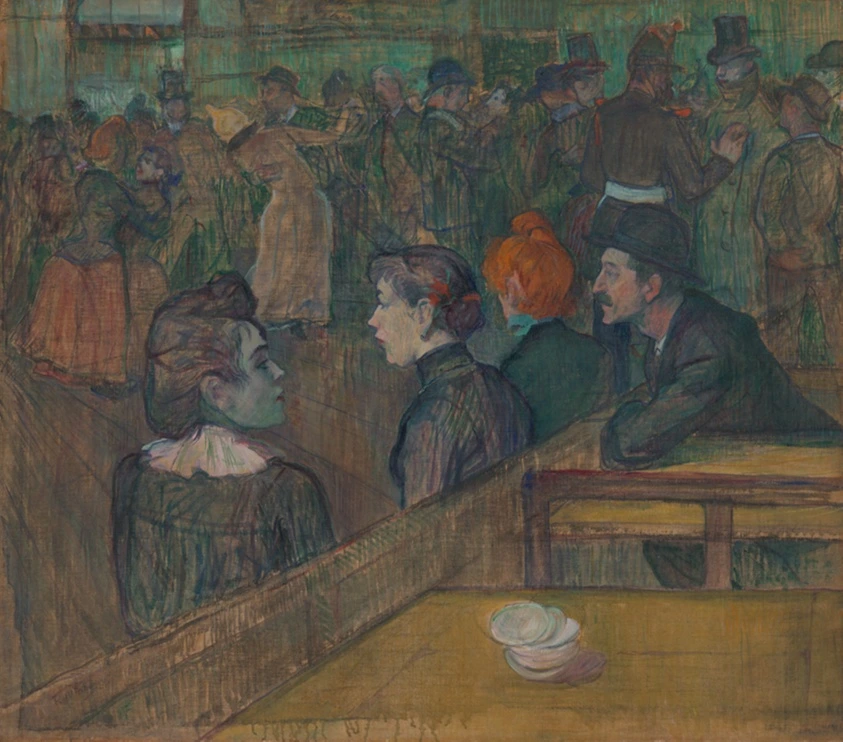
Accession Number
145907
Medium
Oil on paper laid down on board
Dimensions
57.4 × 37.5 cm (22 5/8 × 14 13/16 in.)
Classification
drawings (visual works)
Credit Line
Anonymous loan
Background & Context
Background Story
Henri de Toulouse-Lautrec's "At the Circus Fernando: Medrano with a Piglet" (c. 1889) is an oil on paper laid down on board, depicting a scene from the Cirque Fernando, one of the most popular circuses in late 19th-century Paris. The circus was a favorite subject for Lautrec, who loved the performers, the animals, and the atmosphere of the big top. This work shows Medrano, a famous circus performer or character, with a piglet. The oil on paper technique allows for rapid, spontaneous execution, the paint applied in quick strokes that capture the movement and energy of the scene. The palette is bright and varied, with the colors of the circus creating a festive atmosphere. This painting belongs to the series of circus works that Lautrec produced in the late 1880s and 1890s, which are among his most lively and appealing works. The circus, with its mix of human and animal performers, its humor and its danger, was a perfect subject for Lautrec's art, allowing him to combine his love of popular entertainment with his gifts as a draftsman and observer of character.
Cultural Impact
Lautrec's circus paintings are among the most vivid representations of the circus in art, capturing the energy, humor, and pathos of the performers' lives with unparalleled immediacy.
Why It Matters
This painting of Medrano with a piglet at the circus captures the playful, slightly absurd atmosphere of the popular entertainment that Lautrec loved, the rapid oil technique conveying the energy of the performance.