Provenance
The artist's brother, Theo van Gogh (1854–1891), Paris; by descent to his widow, Johanna Cohen Gosschalk-Bonger (1862–1925). C. M. van Gogh, by January 1911 [Hijbroek and Wouthuysen 1993]. Artz en de Bois, Haarlem, by July 1912 [de la Faille 1928]. J. H. de Bois, Haarlem, by 1916–1926 [Hijbroek and Wouthuysen 1993]; sold to The Leicester Gallery (closed 1928), London [de la Faille 1928]. Kraushaar Gallery, New York, by 1928 [New York 1928]; sold to Mrs. Lewis L. Coburn (1856–1932), Chicago; sold to Walter S. (1872–1954) and Kate L. Brewster (c. 1879–1947), Chicago, 1929 [letter from Walter S. Brewster to Lewis L. Coburn dated May 1, 1929 in museum archives]; bequeathed by Kate L. Brewster to the Art Institute, 1949.
Accession Number
65479
Medium
Charcoal, reed pen and black ink, blue pastel, and white chalk on blue-gray laid paper
Dimensions
47 × 62.1 cm (18 9/16 × 24 7/16 in.)
Classification
charcoal
Credit Line
Bequest of Kate L. Brewster
Background & Context
Background Story
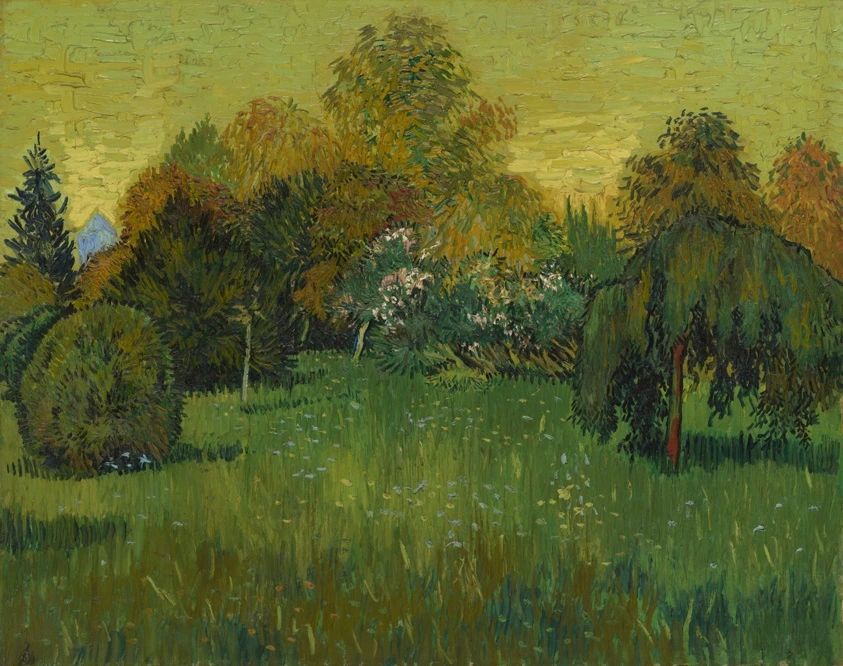
Vincent van Goghs Cottages with a Woman Working in the Middle Ground from 1890 is a charcoal, reed pen and ink, blue pastel, and white chalk drawing on blue-gray laid paper that represents one of the last drawings the artist produced before his death in July 1890, depicting the thatched cottages of the village of Auvers-sur-Oise with the combination of compositional mastery and emotional intensity that distinguishes his final works. Van Gogh, who had moved to Auvers in May 1890 to be near Dr. Paul Gachet and to benefit from the therapeutic effects of the countryside, produced an extraordinary burst of creative energy in the seventy days between his arrival and his death, completing about seventy paintings and numerous drawings that represent the culmination of his artistic development. The thatched cottages of Auvers, which reminded van Gogh of the thatched roofs of his native Netherlands, provided him with a subject that connected the French landscape to the Dutch countryside of his childhood, and the woman working in the middle ground, a small but vividly rendered figure, connects the landscape to the agricultural life that was the economic basis of the village. The combination of charcoal, reed pen and ink, blue pastel, and white chalk on blue-gray paper reveals the drawing technique that van Gogh developed in his final period, in which multiple drawing materials are layered to create a surface of extraordinary chromatic and textural richness that approaches the visual complexity of a painting. The blue-gray laid paper provides a ground that is simultaneously the sky and the atmosphere of the landscape, a single surface on which the cottages and the figure are built up through the successive layers of drawing material.
Cultural Impact
Van Goghs Auvers drawings are among the most significant works of his final period, and Cottages with a Woman Working demonstrates the combination of compositional mastery and emotional intensity that distinguishes his last works. The drawing influenced the development of expressive landscape drawing and the broader tradition of art that approaches drawing as a medium of chromatic and textural complexity.
Why It Matters
A 1890 charcoal, reed pen and ink, blue pastel, and white chalk drawing by van Gogh on blue-gray laid paper depicting Auvers thatched cottages with a woman working, one of his last drawings before death, layering multiple materials to achieve chromatic and textural complexity that approaches painting.