Accession Number
31289
Medium
Watercolor on cream wove paper
Dimensions
29.8 × 25.2 cm (11 3/4 × 9 15/16 in.)
Classification
watercolor
Credit Line
Olivia Shaler Swan Memorial Collection
Background & Context
Background Story
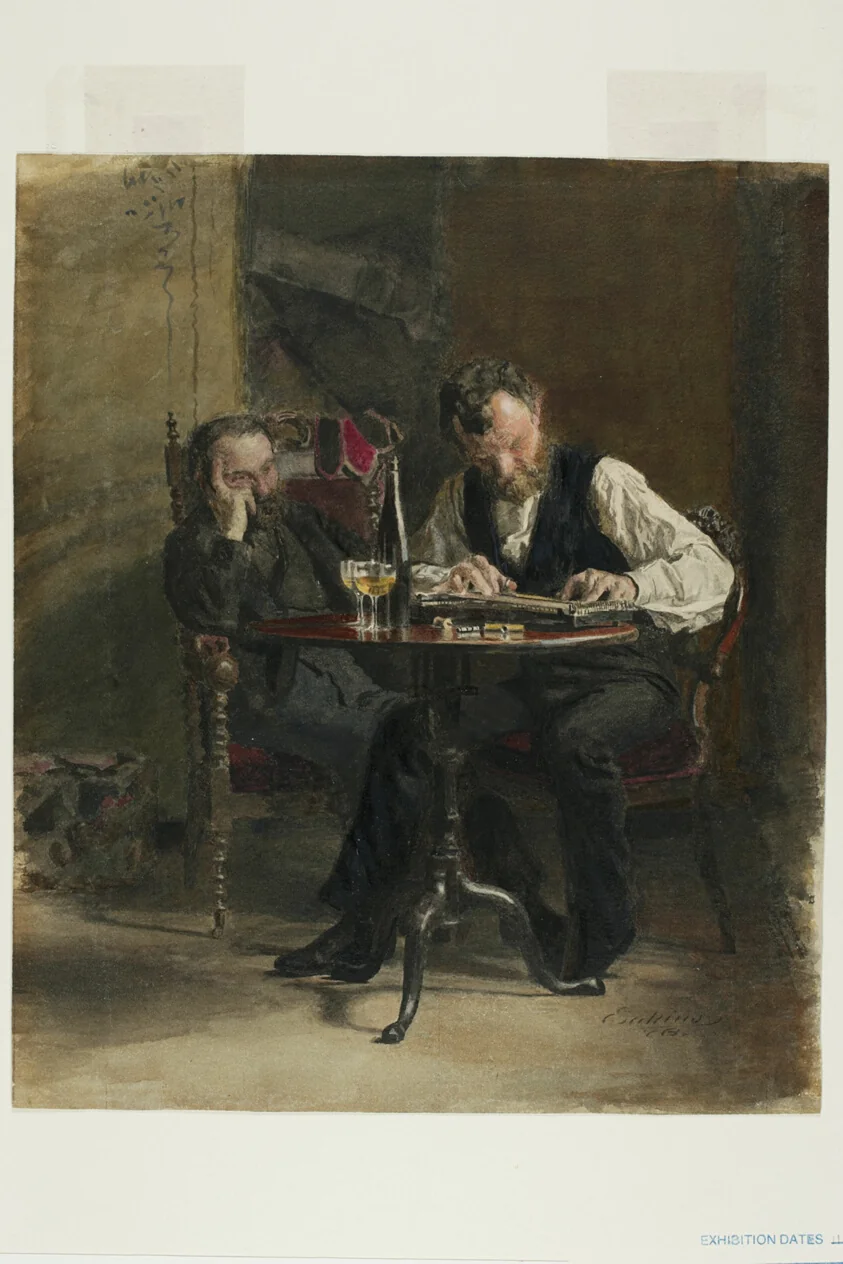
"The Zither Player" is an 1876 watercolor by Thomas Eakins that captures the American realist painter in his most intimately musical and delicately observational mode, the image showing a zither player rendered with the same attention to human character and physical presence that characterized his most powerful portraits. The composition is a medium-sized watercolor—29.8 × 25.2 centimeters—showing a musician with the watercolor on cream wove paper creating a surface of extraordinary delicacy and human warmth. The cream wove paper provides a warm, luminous ground that makes the watercolor tones appear rich and inviting, enhancing the sense of musical intimacy and quiet observation. The 1876 date places this work in the period of Eakins's early maturity and his engagement with the musical culture of Philadelphia, when he was producing the watercolors and drawings that documented the human types and cultural life of his native city. Art historians have connected this watercolor to the broader tradition of the musical subject in American art, from the paintings of Mount to the photographs of the period, noting that Eakins's treatment is more focused on the human presence and the quiet observation, the transformation of musical performance into visual portraiture, than the dramatic expression or the theatrical gesture of these other traditions.
Cultural Impact
This 1876 watercolor made zither musician intimately warm through medium 29cm delicate watercolor and cream-paper luminous human presence, using early-mature Philadelphia musical-culture documentation to transform performance into quiet realist portraiture beyond Mount theatrical dramatic gesture.
Why It Matters
It matters because Eakins painted someone playing a zither and made the paper feel like it was listening to a private concert—proving that even a sketch could be music if the observation was tender enough.