Description
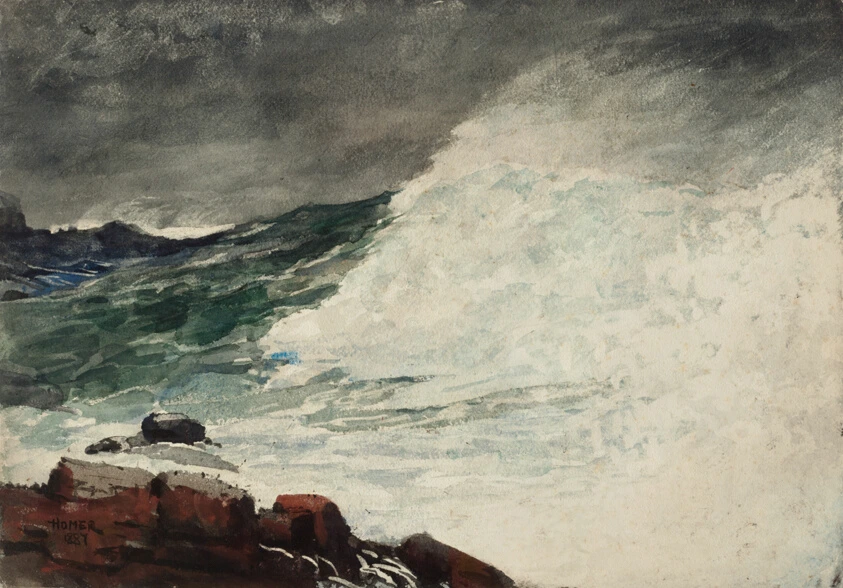
Philip Beam has identified the site for Prout’s Neck, Breaking Wave as “the shoreline a little above water’s edge in the vicinity of Cannon Rock, looking toward High Cliff,” adding that Homer “fished from this point almost daily during the summer and fall and must have seen such waves "a thousand times" (Beam 1966, n.p.). Homer’s familiarity with the site is born out by the techniques that he used to capture the relentless churning movement of the massive wave. Although he used very little graphite in this work, he mapped out the frothy whites of the wave by making staccato marks with resist, probably using chalk for this purpose. Homer used almost every trick he knew to achieve the varied textures of water, shore, and sky, including layering, blotting, rewetting, and scraping. Although carefully planned and carried out, the final effect is vigorous and immediate.
Provenance
Accession Number
16818
Medium
Transparent watercolor, with touches of opaque watercolor, rewetting, blotting and scraping, over resist and traces of graphite, on medium weight, moderately textured, ivory wove paper, laid down on cream wove paper
Dimensions
38 × 54.4 cm (15 × 21 7/16 in.)
Classification
watercolor
Credit Line
Mr. and Mrs. Martin A. Ryerson Collection