Provenance
Rolf de Maré (1888–1964), Paris by 1932 [Hugnet 1932]. Eugenia Huici de Errázuriz (1859–1951), Paris, by 1934 [Hartford 1934]. Rolf de Maré, Paris and Sweden, by 1942–1951 [Zervos 1942 and Gieure 1951]. Mr. and Mrs. Leigh Block, Lake Forest, Ill. and Santa Barbara, Calif.; given to the Art Institute, 1952.
Accession Number
109260
Medium
Oil on canvas
Dimensions
130.2 × 89.5 cm (51 1/4 × 35 1/4 in.)
Classification
Painting
Credit Line
Gift of Mrs. Leigh B. Block in memory of Albert D. Lasker
Background & Context
Background Story
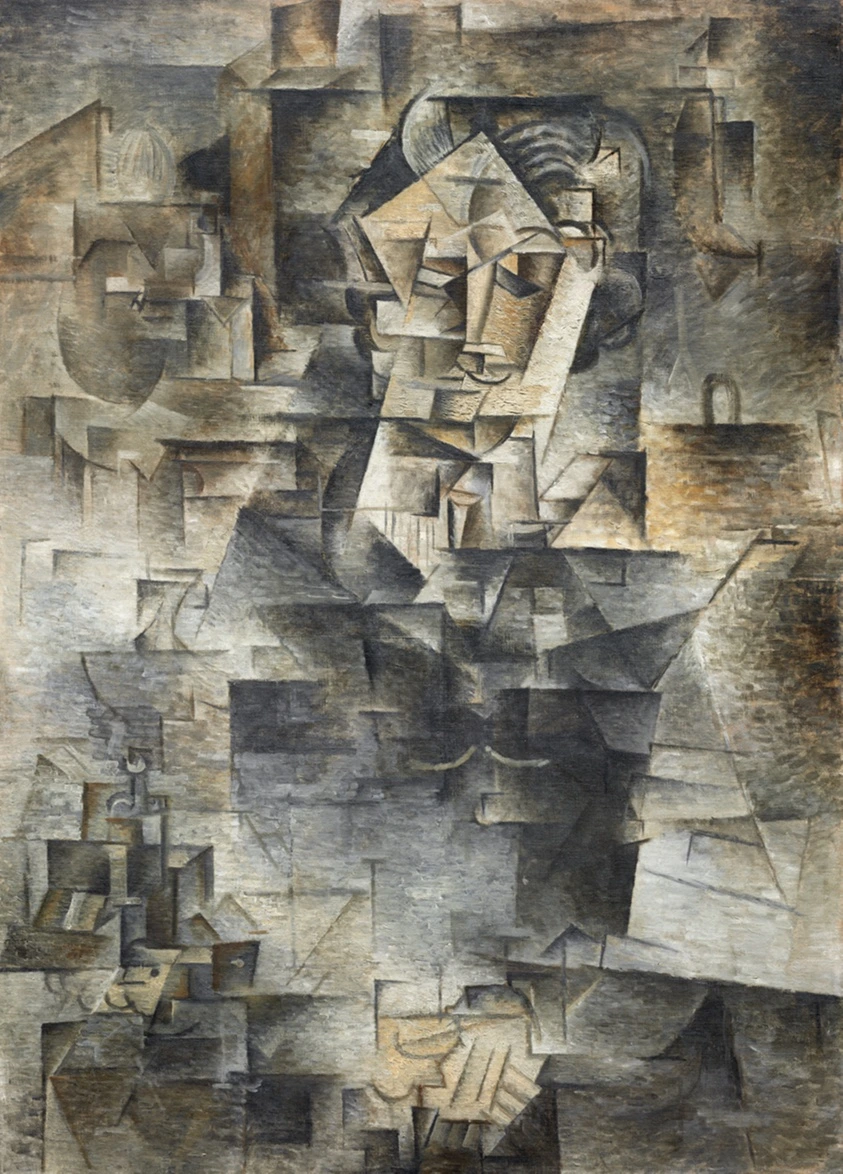
Painted in 1915, "Man with a Pipe" occupies a critical position in Picasso's transition from Analytic to Synthetic Cubism, when the artist began reintroducing recognizable subjects and brighter colors after the austere monochrome of the earlier phase. The sitter is probably the artist himself, though some scholars have suggested the poet Max Jacob or the dealer Daniel-Henry Kahnweiler. The figure is constructed from intersecting planes of muted brown, gray, and ochre, with the pipe itself—a traditional attribute of the thinker and bohemian—serving as the one element that survives relatively intact from pre-Cubist representation. This strategic preservation of a single recognizable object within a field of abstraction is characteristic of Synthetic Cubism, in which fragments of reality are reassembled into new pictorial wholes. The canvas also reveals Picasso's growing interest in texture: areas of the surface are scraped and repainted, creating a physical topography that extends the painting into the third dimension. The political context is important: 1915 was the second year of World War I, and Picasso— exempted from military service as a Spanish citizen—was painting in Paris while friends and colleagues were dying at the front. The man with a pipe may carry some of this guilt and isolation, the solitary intellectual confronting a catastrophe he cannot prevent. The work influenced the development of Synthetic Cubism among Picasso's contemporaries, including Braque and Gris, and it anticipated the incorporation of collage elements that would define the movement's next phase.
Cultural Impact
This canvas codified Synthetic Cubism by preserving a single recognizable object—the pipe—within abstract decomposition, demonstrating that fragmentation could coexist with memory.
Why It Matters
It matters as Picasso's coded self-portrait in wartime—an artist who could not fight, painting a man who could only think and smoke.