Provenance
Cyrus H. Adams, Jr. (1881–1968), Chicago; by descent to his daughter, Mary Adams Young, Chicago, 1968; given to the Art Institute of Chicago, 1985.
Accession Number
103900
Medium
Graphite on buff wove paper (discolored to tan)
Dimensions
10.2 × 16.2 cm (4 1/16 × 6 7/16 in.)
Classification
graphite
Credit Line
Gift of Mary Adams Young from the estate of her father Cyrus H. Adams Jr.
Background & Context
Background Story
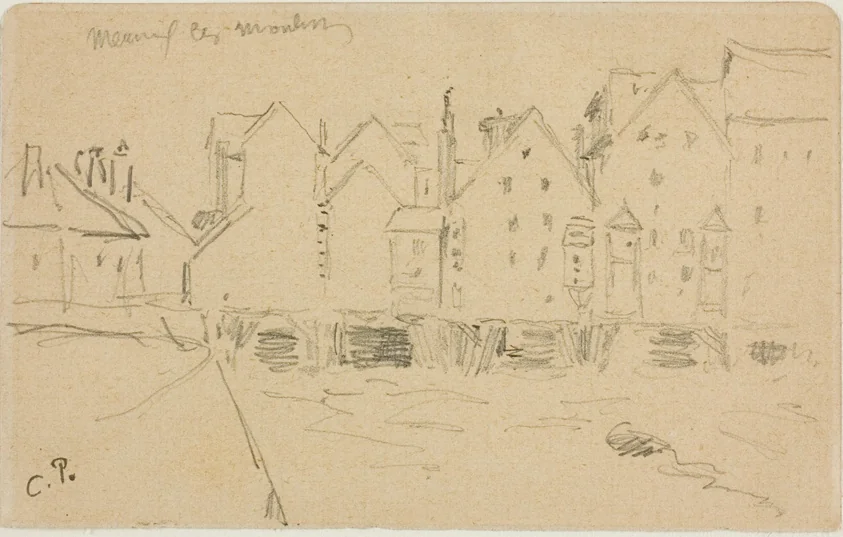
Camille Pissarro's "Water Mills in Meaux" (c. 1898) is a graphite drawing on buff wove paper showing the water mills of Meaux, a town east of Paris. In the 1890s, Pissarro produced numerous drawings and paintings of river scenes, particularly views of the Seine and its tributaries. This drawing of water mills shows Pissarro's late graphite technique at its most refined: the forms are built through precise, parallel hatchings that model the volumes of the buildings and the movement of the water. The buff paper provides a warm foundation. Pissarro's late drawings are often undervalued compared to his paintings, but they reveal his extraordinary draftsmanship and his ability to capture complex architectural and natural forms with nothing but graphite on paper. The water mills—functional industrial buildings powered by water—were subjects that appealed to Pissarro's interest in the intersection of nature and human labor.
Cultural Impact
Pissarro's late graphite drawings demonstrate the foundation of his art: a mastery of drawing that underlay all his experiments with color and light.
Why It Matters
This graphite drawing of water mills shows Pissarro's refined late draftsmanship, the careful hatchings capturing both the architecture of the mills and the movement of the water that powered them.


