Provenance
Estate of the artist, from 1903 [estate stamp recto, lower right, in blue ink]; by descent to the artist’s son, Ludovic-Rodo Pissarro (1878–1952), Paris and London. Given by Kasriel Tausk (1918–2006), Chicago, to the Art Institute of Chicago, 1984.
Accession Number
102693
Medium
Graphite on light gray laid paper
Dimensions
31.1 × 46.2 cm (12 1/4 × 18 1/4 in.)
Classification
graphite
Credit Line
Gift of Kasriel Tausk in memory of Harold Joachim
Background & Context
Background Story
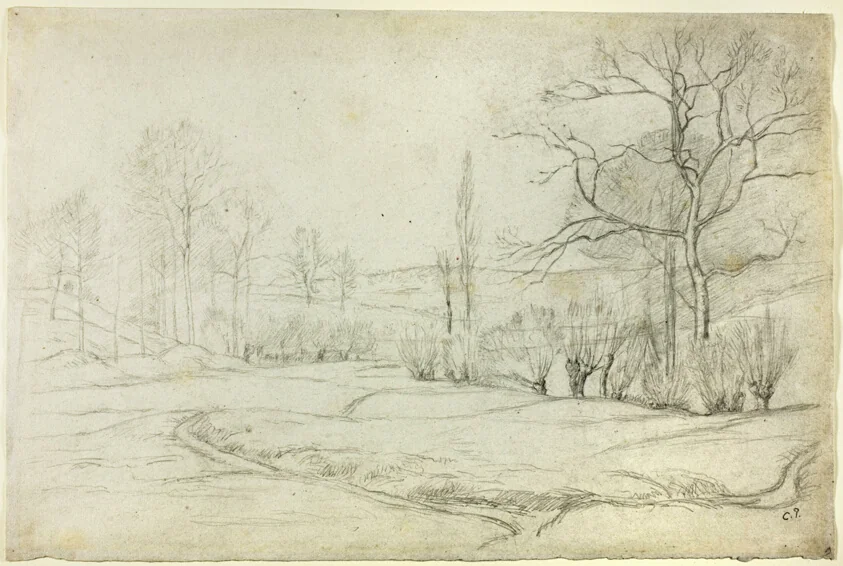
Camille Pissarro's "Landscape in Montfoucault" (1864) is an early graphite drawing on light gray laid paper from the period when Pissarro was still developing his mature style. Montfoucault was a village in Brittany where Pissarro's friend the painter Ludovic Piette had a farm, and Pissarro often visited to paint the Breton landscape. This drawing from 1864 shows a landscape with trees, fields, and perhaps farm buildings, executed in a careful, structured graphite technique that reveals Pissarro's academic training. The handling is more deliberate than his later, freer drawings, with the forms built through systematic hatching. The gray paper provides a neutral ground. This early work is valuable for understanding Pissarro's development: it shows a young artist learning to structure a landscape, carefully observing the relationships between different elements before he developed the looser, more spontaneous approach of his Impressionist maturity.
Cultural Impact
Pissarro's early drawings document his artistic formation and the academic discipline that underlay the revolutionary freedom of his Impressionist style.
Why It Matters
This early graphite landscape shows Pissarro learning to see and structure the natural world, the careful hatching revealing the discipline and observation that would flourish into the freedom of his mature art.


