Cross and Weather Vane

Description

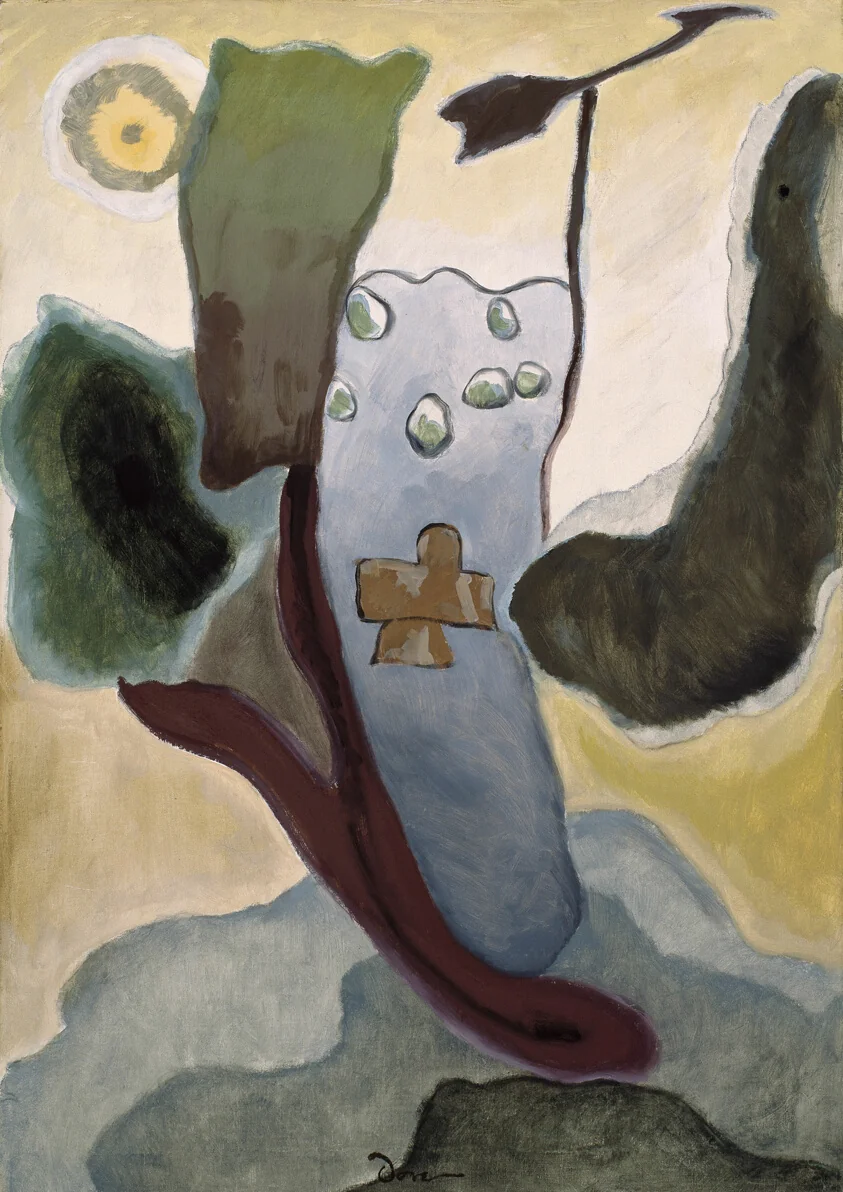
In 1933 Arthur Dove and his wife, Helen Torr, moved to Geneva, New York, where he had been raised and where he found renewed inspiration in the local landscape. Dove began exploring it in depth, producing canvases such as Cross and Weather Vane. The composition incorporates trees, rolling hills, and the round orb of the sun—all natural elements that recur with frequency in the artist’s work. These features mingle harmoniously with the manmade objects in the painting, such as the arrow-shaped weather vane, which seems to take flight like a bird. The small brown cross, positioned against a gray, rocklike form, represents Dove’s belief in the interconnectedness of spirituality and nature.

Cross and Weather Vane

Arthur Dove

1935

Accession Number

65893

Medium

Oil on canvas

Dimensions

88.3 × 62.6 cm (34 3/4 × 24 5/8 in.)

Classification

oil on canvas

Museum

The Art Institute of Chicago

Chicago, United States

Credit Line

Alfred Stieglitz Collection
Background & Context

Background Story

Arthur Dove's "Cross and Weather Vane" (1935) is an oil on canvas that combines two symbolic forms—the Christian cross and the weather vane—into a single, spare composition. The cross is one of the most charged symbols in Western culture, while the weather vane is a humble, practical object that indicates the direction of wind. By pairing them, Dove creates a meditation on the intersection of the sacred and the mundane, the eternal and the transient. The composition is characteristically simple and direct, with the forms of cross and weather vane reduced to their essential shapes. The palette is restrained, perhaps using earth tones and muted colors. This painting belongs to Dove's series of works that incorporated recognizable symbolic forms into abstract compositions, a practice that distinguished him from European abstract artists who typically avoided such references. The year 1935 was a difficult one for Dove—he was struggling with poor health and financial difficulties—but his art continued to explore the deepest questions of human experience through the simplest means.

Cultural Impact

Dove's incorporation of symbolic forms into abstract compositions represented a distinctively American approach to abstraction, maintaining a connection to recognizable experience that European pure abstraction often rejected.

Why It Matters

"Cross and Weather Vane" demonstrates Dove's ability to invest simple, everyday forms with profound spiritual and philosophical meaning, the abstract composition becoming a meditation on the eternal and the ephemeral.