Accession Number
237322
Medium
Lithograph and watercolor on wove paper
Dimensions
26.2 × 34.1 cm (10 3/8 × 13 7/16 in.)
Classification
lithograph
Credit Line
Gift of David Q. and Mary H. Bell
Background & Context
Background Story
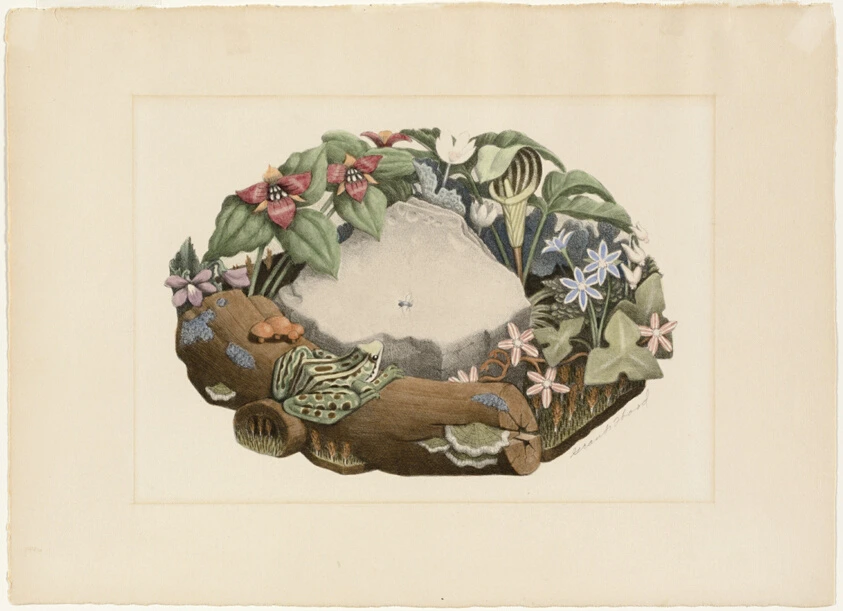
Grant Woods Fruits from 1939 is a lithograph with watercolor that depicts an abundant still life of American fruits with the crisp outlines, decorative patterns, and humorous affection for vernacular culture that characterize the artists Regionalist style. Wood, best known for American Gothic and other paintings of rural Midwestern life, produced a series of lithographs in the late 1930s that applied his precise, gently satirical style to still-life subjects, treating fruits, vegetables, and other humble objects with the same formal rigor and decorative elegance that he brought to his portraits and landscapes. In Fruits, the various specimens, apples, pears, grapes, and other varieties, are arranged on a surface with a geometric precision that recalls both the tradition of Dutch Golden Age still life and the product displays of American grocery stores, a combination typical of Woods ability to find high art precedents for low art subject matter. The watercolor added to the lithographic base provides local color that enlivens the black-and-white printing with a decorative chromatic range, a technique Wood borrowed from the tradition of hand-colored prints that was common in 19th-century American popular art. The year 1939 places this lithograph in the period when Wood was teaching at the University of Iowa and producing some of his most accomplished work in various media, including the stone lithographs that were his primary contribution to American printmaking.
Cultural Impact
Woods lithographs with watercolor are among the finest examples of American Regionalist printmaking, demonstrating that the movement associated with his paintings was equally accomplished in graphic media. His treatment of humble subjects with formal rigor and decorative wit influenced the development of American still-life and the broader tradition of finding artistic significance in everyday objects.
Why It Matters
A lithograph with watercolor by Wood depicting an abundant American fruit still life with Regionalist precision and decorative wit, combining Dutch Golden Age precedents with vernacular product-display aesthetics in a characteristically affectionate treatment of humble subject matter.