Provenance
Mme Béatrice Bretty (née Anne-Marie Bolchiesi; 1893–1982), Paris. Knoedler Gallery, New York. Bénézit, Paris. Fernand C. Graindorge (1903–1985), Liège, Belgium [all provenance Dortu 1971]. Sold, Hôtel Drouot, Paris, October 25, 1950, lot 86, to Dorothy Braude Edinburg; given to the Art Institute, 1998.
Accession Number
150832
Medium
Charcoal, with black chalk, stumping, and erasing, heightened with white chalk, on brown laid paper with blue fibers
Dimensions
50.8 × 36.6 cm (20 × 14 7/16 in.)
Classification
charcoal
Credit Line
Gift of Dorothy Braude Edinburg to the Harry B. and Bessie K. Braude Memorial Collection
Background & Context
Background Story
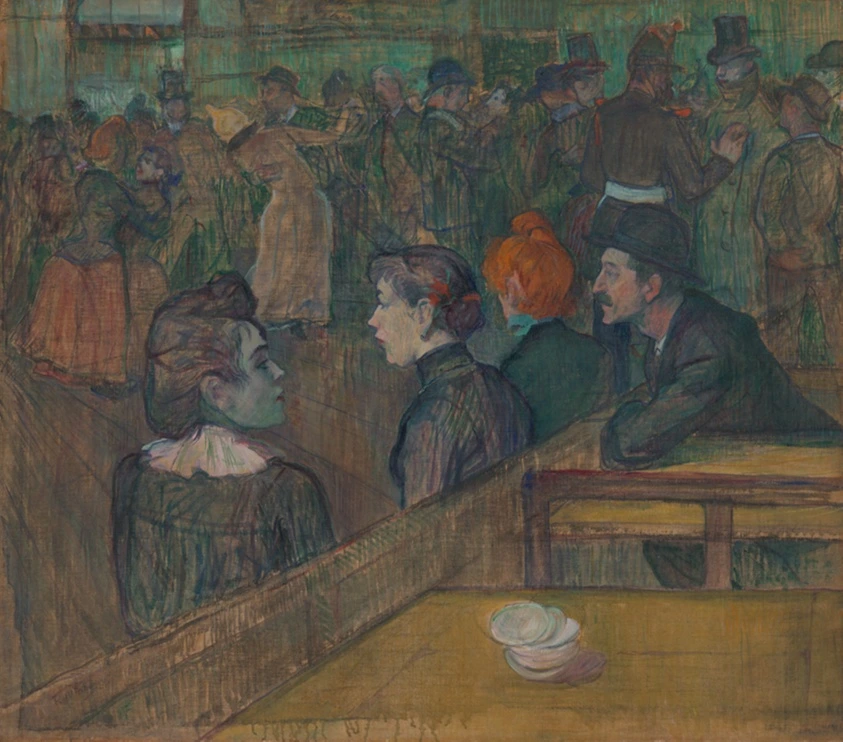
Henri de Toulouse-Lautrec's "Old Woman" (1882) is a charcoal drawing with black chalk, stumping, and erasing, heightened with white chalk on brown laid paper with blue fibers. This early work from 1882, when Lautrec was 18, shows a study of an elderly woman, perhaps a model or a figure from his immediate circle. The treatment is more academic and less flamboyant than Lautrec's later works, reflecting his training in the studios of academic painters. The combination of charcoal and black chalk with white heightening on brown paper follows the traditional academic technique of drawing on tinted paper. The stumping creates soft transitions of tone. The brown paper with blue fibers provides a distinctive, textured ground. The old woman's features are rendered with care and sympathy, the wrinkles and signs of age captured without sentimentality. This early study shows the young Lautrec mastering the traditional techniques of academic draftsmanship before he developed the more personal, expressive style of his mature career.
Cultural Impact
Lautrec's early academic studies document the traditional training that underlay his revolutionary later work, showing the discipline of observation and technique that made his mature style possible.
Why It Matters
This early study of an old woman shows the 18-year-old Lautrec mastering the academic techniques of charcoal and chalk on tinted paper, the careful modeling and sympathetic observation revealing the foundation of his later genius.