Provenance
Roger Marx; sold, Manzi-Joyant, Paris, May 11-12, 1914, lot 221 [according to Joyant but dimensions do not match]. Albert Sancholle Henraux (died 1953), Paris, by November 1932-at least February 1941 [Paris 1932; New York 1941]. Given by Leigh B. Block, Chicago, to the Art Institute, 1954.
Accession Number
80091
Medium
Oil paint and watercolor, over charcoal, on tan wove tracing paper, laid down on cream woodpulp card
Dimensions
61.9 × 48.7 cm (24 3/8 × 19 3/16 in.)
Classification
oil paintings (visual works)
Credit Line
Gift of Mrs. Leigh B. Block
Background & Context
Background Story
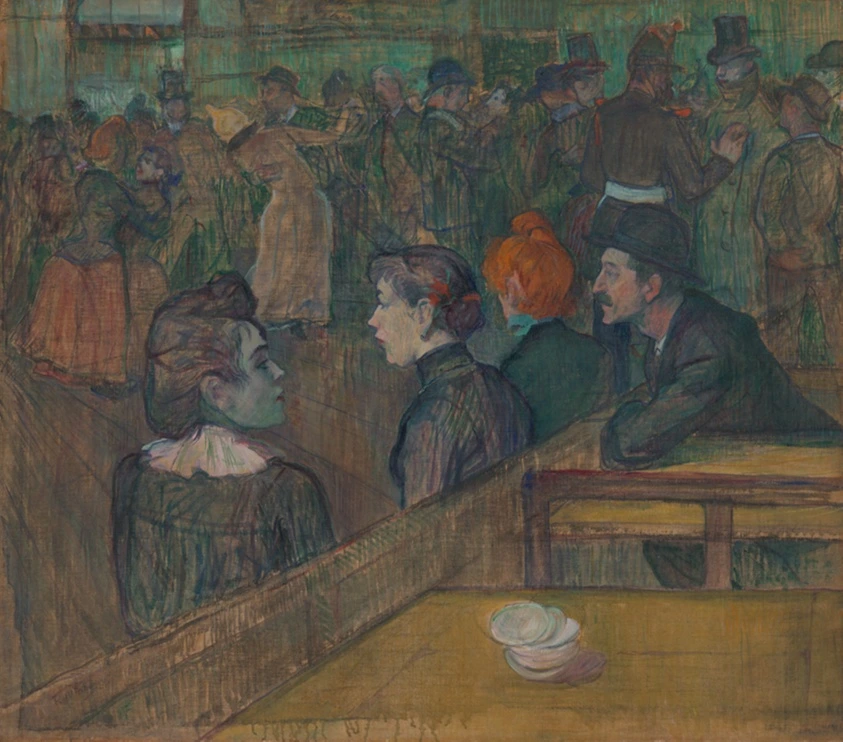
Henri de Toulouse-Lautrecs La Macarona in the Costume of a Jockey from 1893 depicts a performer from the Parisian demi-monde dressed in jockey silks, a subject that exemplifies Lautrecs lifelong fascination with the overlap between the worlds of entertainment, sport, and sexual commerce in fin-de-siecle Paris. La Macarona, whose stage name suggests Italian origins, may have been a performer at one of the cabarets or music halls that Lautrec frequented and depicted throughout his career. The jockey costume, with its bright colors and form-fitting silhouette, creates a visual pun that connects the world of horse racing, a sport dominated by the upper classes, with the world of performance, where the same silks could be worn as a provocative costume rather than a utilitarian garment. The mixed media, oil paint and watercolor over charcoal on tracing paper laid down on card, reveals Lautrecs working process: the charcoal underdrawing establishes the composition and the major contours, the watercolor adds chromatic accents, and the oil paint provides opacity and richness in the areas that require the most emphasis. The tracing paper support, unusual for a finished work, suggests that Lautrec may have transferred the composition from another drawing or that he was using the transparency of the paper to work out the placement of the figure against the background. The year 1893 places this work in Lautrecs most productive period, when he was producing the posters and paintings that would make him the preeminent visual chronicler of Parisian nightlife.
Cultural Impact
Lautrecs depictions of performers in costume are foundational documents of fin-de-siecle Parisian visual culture, and their influence extends from the graphic design of the Art Nouveau poster to the photographic representation of celebrity and nightlife in the 20th century. His mixed media technique influenced the development of works on paper as an independent artistic medium rather than a preparatory step.
Why It Matters
A mixed media depiction of a Parisian performer in jockey silks by Lautrec, using oil, watercolor, and charcoal on tracing paper to capture the provocative overlap of entertainment and sport in fin-de-siecle Paris, exemplifying his role as the visual chronicler of Parisian nightlife.