Provenance
Estate of the artist, from 1901 [Lugt 1338]. Dr. Gabriel Tapié de Céleyran, by 1927 [Joyant 1927]. Hector Brame (1866-1936), Paris [Dortu 1971]. Sold by César de Hauke, Paris, to the Art Institute, 1951.
Accession Number
74782
Medium
Graphite on ivory wove paper
Dimensions
25.2 × 15.9 cm (9 15/16 × 6 5/16 in.)
Classification
chalk
Credit Line
David Adler Memorial Fund
Background & Context
Background Story
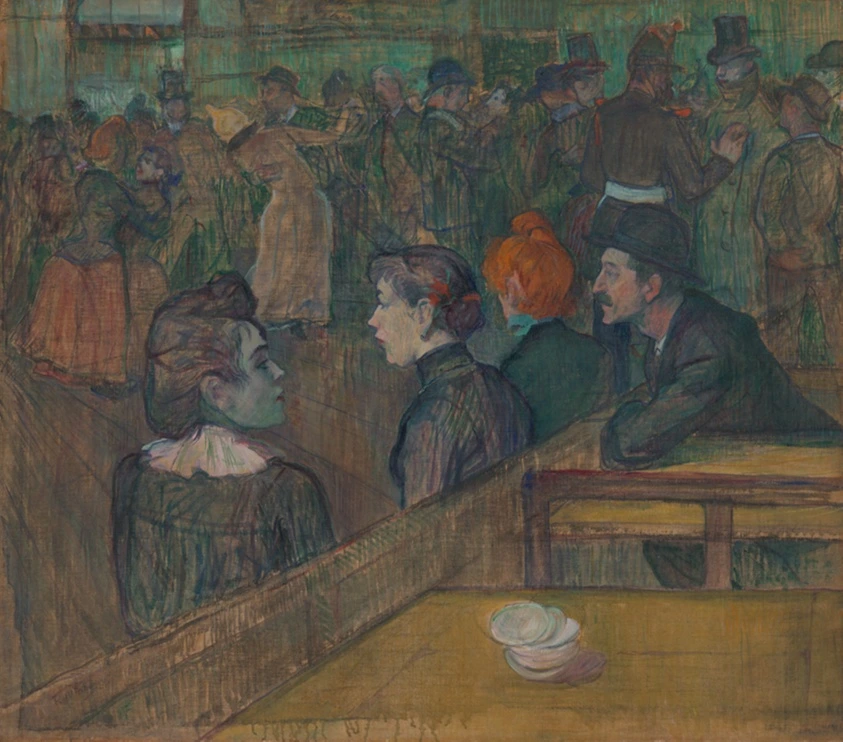
Henri de Toulouse-Lautrec's "Study: Face of Woman with High Collar" (c. 1894) is a graphite drawing on ivory wove paper that focuses on the face of a woman wearing a high collar—perhaps a fashionable dress or a performer's costume. The high collar frames the face, drawing attention to the features. Lautrec's treatment is characteristically economical: a few lines define the eyes, the nose, the mouth, the shape of the face, while the collar is suggested with broader, simpler strokes. The graphite technique is refined and controlled, the lines varying in pressure to create a sense of volume and character. The ivory wove paper provides a smooth, warm ground. The woman's identity is not certain, but she may be one of the performers or fashionable women who populated Lautrec's world. This study, with its focus on the face framed by the high collar, is a concentrated exercise in portraiture, capturing the essence of a face with the minimum of means.
Cultural Impact
Lautrec's focused portrait studies demonstrate his ability to capture the essential character of a subject with remarkable economy, reducing the complexity of the human face to its most expressive lines.
Why It Matters
This graphite study of a woman with a high collar captures the elegance and character of its subject with extraordinary economy, the few lines of the face and collar creating a vivid portrait.