Provenance
Estate of the artist [stamp recto, lower right, in red ink; Lugt 1338]. Maurice Joyant (1864-1930), Paris, before 1931 [Paris 1931]. M. G. Dortu (died 1984), Paris, by 1931 [Paris 1931]. Maurice Loncle, Paris, by July 1949 [letter from Carl Schniewind to Carter Harrison of July 20, 1949, in curatorial file]. Alexandrine de Rothschild (died 1965), Paris [Joachim 1978]. Norton Simon (1907-1993), Pasadena, Calif. [Joachim 1978]. Sold by E. V. Thaw and Company, New York, to the Art Institute, 1972.
Accession Number
41315
Medium
Charcoal, pastel, and black chalk, with stumping, touches of colored pencil, and incising, on off-white wove paper
Dimensions
21.7 × 31.6 cm (8 9/16 × 12 1/2 in.)
Classification
pastel
Credit Line
Gift of Mr. and Mrs. B. E. Bensinger
Background & Context
Background Story
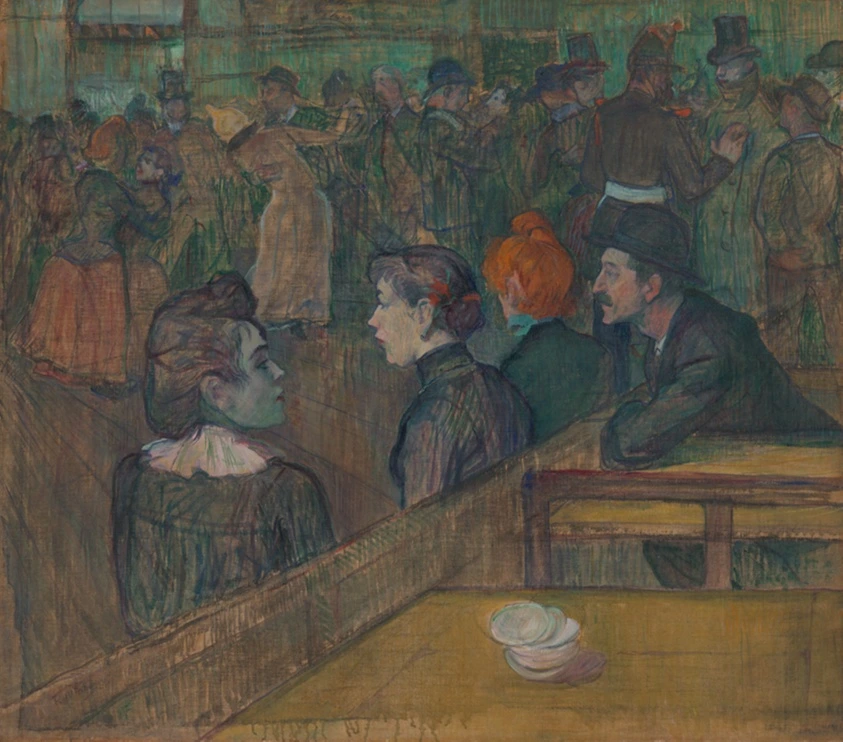
Henri de Toulouse-Lautrec's "At the Circus: Work in the Ring" (1899) is another drawing from the 1899 circus series, executed in charcoal, pastel, and black chalk with stumping, touches of colored pencil, and incising on off-white wove paper. This drawing shows the activity in the circus ring, perhaps performers preparing for an act or the ringmaster directing the show. The combination of media creates a rich, varied surface: the charcoal and black chalk provide dark tones, the pastel adds color, the stumping creates soft transitions, and the incising adds texture by scratching into the surface of the paper. The composition is lively and dynamic, capturing the movement and activity of the circus ring. Lautrec's circus drawings of 1899 are remarkable for their energy and vitality, qualities that are all the more striking given the circumstances of their creation. This drawing, with its complex mix of media and its lively subject, is one of the finest of the series.
Cultural Impact
Lautrec's 1899 circus drawings represent one of the most remarkable achievements in the history of drawing, a series of works created under extreme personal duress that capture the joy and energy of the circus with undiminished vitality.
Why It Matters
This drawing of work in the circus ring captures the bustling activity behind the performance, the mixed media technique creating a rich surface that conveys the energy and atmosphere of the circus.