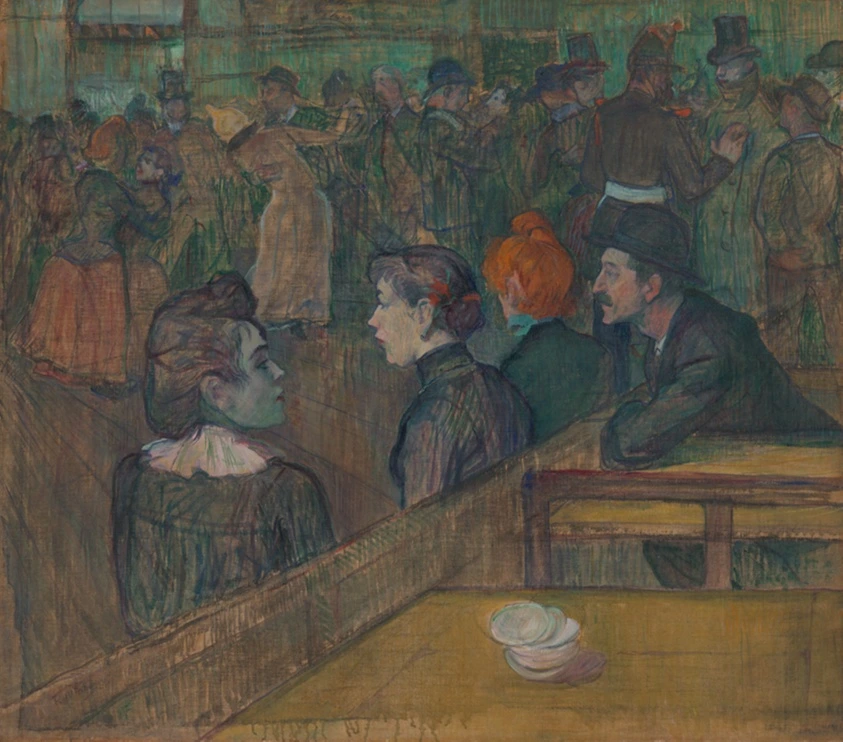
Provenance
Sold by Imberti Gallery, Bordeaux, to Gustave Fayet (1865-1925), Carcassonne, France, May 1905 [according to Fondation Louis Vuitton email dated June 10, 2024]. Heim, Munich; sold, Hôtel Drouot, Paris, April 30, 1913, Heim sale, lot 12, as "Café Concert," to Eugène Blot [Dortu 1971]; sold, Hôtel Drouot, Paris, June 2, 1933, Blot sale, lot 22, to Bergaud, Paris [Dortu 1971]. Duhem [Joachim 1978]. Private Collection, France [invoice]. Sold by Wildenstein and Company, New York, to the Art Institute, 1965.
Accession Number
22859
Medium
Graphite and red chalk, with touches of black crayon, heightened with traces of white chalk, on ivory wove paper
Dimensions
35.1 × 25.4 cm (13 7/8 × 10 in.)
Classification
chalk
Credit Line
Purchased with funds provided by the Joseph and Helen Regenstein Foundation
Background & Context
Background Story
Henri de Toulouse-Lautrec's "Mademoiselle Cocyle as Helen of Troy in La Belle Helene" (1900) is a graphite and red chalk drawing with touches of black crayon, heightened with traces of white chalk on ivory wove paper. The subject is Mademoiselle Cocyle, a performer in Jacques Offenbach's operetta "La Belle Hélène" (The Beautiful Helen), a comic retelling of the story of Helen of Troy. Lautrec's drawing captures the performer in costume as Helen, the classical subject rendered with his characteristic modern, ironic sensibility. The combination of graphite and red chalk creates a warm, lively effect, the red chalk adding a sense of life to the features. The touches of black crayon add depth, and the white chalk highlights add luminosity. The ivory wove paper provides a smooth ground. This late work from 1900, the year before Lautrec's death at 36, shows his powers undiminished. The comic operetta, with its mix of classical allusion and popular entertainment, was the perfect subject for an artist who had spent his career bringing high artistic skill to the depiction of popular culture.
Cultural Impact
Lautrec's portraits of performers in Offenbach's operettas capture the intersection of classical culture and popular entertainment that characterized fin-de-siècle Parisian theater.
Why It Matters
This portrait of Mademoiselle Cocyle as Helen of Troy captures the wit and elegance of Offenbach's comic operetta, the graphite and red chalk technique creating a lively image that matches the spirit of the performance.