Provenance
Colonel Wild [Joyant 1930]. Eugène Mutiaux (died 1925), Paris [Joyant 1930]. Otto Gerstenberg (1848-1935), Berlin [Gaehtgens and Scharf, 2001]; by descent to his daughter, Margarethe Scharf (died 1961); by descent to her son, Walter Scharf (died 1996) [Chicago 1974]. Sold by Dr. Fritz Nathan, Zurich, to the Art Institute, 1965.
Accession Number
22624
Medium
Blue crayon and brush and black and gray wash, with touches of orange crayon, heightened with touches of white oil paint, on tan wove card
Dimensions
47 × 23.5 cm (18 9/16 × 9 5/16 in.)
Classification
crayon
Credit Line
Purchased with funds provided by the Joseph and Helen Regenstein Foundation
Background & Context
Background Story
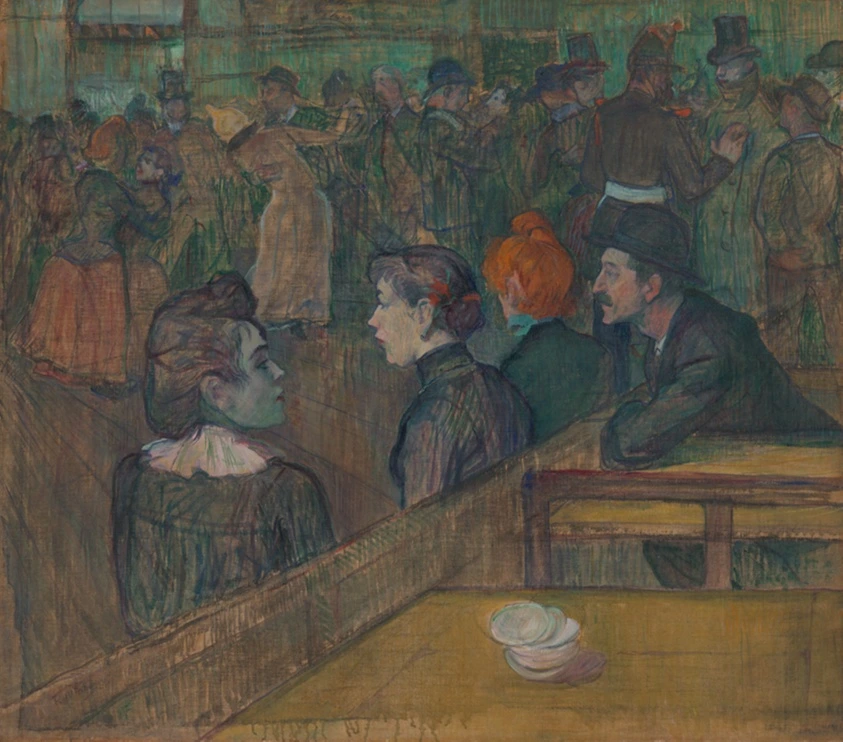
Henri de Toulouse-Lautrec's "At the Door" (1885) is a blue crayon and brush and black and gray wash drawing with touches of orange crayon, heightened with touches of white oil paint on tan wove card. This early work from 1885 shows a figure at a door, the composition suggesting a moment of arrival or departure. The blue crayon provides the basic structure, the brush and wash adds tonal depth, the touches of orange crayon add a note of warmth, and the white oil paint provides highlights. The combination of media is unusually rich for Lautrec and shows the young artist experimenting with different materials and techniques. The tan wove card provides a warm, stable support. The subject—a figure at a door—is simple but suggestive: the door as a threshold, a point of transition between inside and outside, the public and the private. This early work, from the period when Lautrec was establishing himself as an artist in Paris, shows the themes of urban life and social observation that would define his career.
Cultural Impact
Lautrec's early works in mixed media demonstrate his experimental approach to materials and his willingness to combine different techniques in pursuit of the most expressive effect.
Why It Matters
This mixed-media drawing of a figure at a door captures a moment of everyday urban life with unusual richness of technique, the blue crayon and orange accents creating a composition of quiet drama.