Provenance
Commissioned by the sitter; (sale, Galerie Georges Petit, Paris, 23 October 1925); purchased by Chester Dale, New York; bequest 1963 to NGA.[1]
[1]Provenance according to Chester Dale papers in NGA curatorial records.
Accession Number
1963.10.33
Medium
oil on wood
Dimensions
overall: 27.3 x 18.7 cm (10 3/4 x 7 3/8 in.) | framed: 41.9 x 36.5 x 5.1 cm (16 1/2 x 14 3/8 x 2 in.)
Classification
Painting
Credit Line
Chester Dale Collection
Tags
Painting Impressionist & Modern (1851–1900) Oil Painting French
Background & Context
Background Story
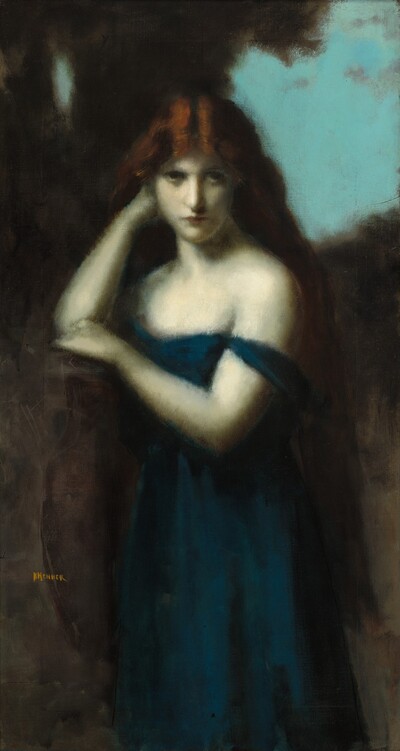
Jean-Jacques Henner (1829-1905) was a French painter known for his portraits and religious subjects rendered in the soft-focus, sfumato manner that became his signature style. Madame Uhring from 1890 is a portrait of a woman with the sfumato modeling and limited palette—blond hair, white skin, dark background—that distinguish Henner's most accomplished portraits. The 1890 date places this in Henner's mature period, when he had developed the sfumato manner that made him one of the most fashionable portrait painters in Paris, and the oil on wood support allows the smooth finish that his sfumato modeling demands.
Cultural Impact
Henner's portraits are important in the history of 19th-century French painting because they demonstrate an alternative to both the academic realism of the Salon and the Impressionist innovation that was transforming French painting in the 1890s. Madame Uhring shows Henner painting in the sfumato manner that refused both the precise modeling of academic painting and the broken color of Impressionism, creating a third way in French portraiture that was both fashionable and distinctive.
Why It Matters
Madame Uhring is Henner's sfumato portraiture at its most accomplished: a woman rendered with the soft-focus modeling and limited palette—blond hair, white skin, dark background—that distinguish his most fashionable portraits. The 1890 painting on wood offers an alternative to both academic realism and Impressionist innovation.