Provenance
Artist's estate; Bernard Ruiz-Picasso (born 1959), Paris. Private collection, New York. Pace Wildenstein, New York; private collection, Bologna, by 1995. Sold, Christie's, New York, Nov. 7, 2001, lot 450, to Richard and Mary L. Gray and the Gray Collection Trust, Chicago (promised to the Art Institute of Chicago, 2018); given to the Art Institute of Chicago, 2022.
Accession Number
202389
Medium
Fabricated black chalk on cream wove paper
Dimensions
30.9 × 19.6 cm (12 3/16 × 7 3/4 in.)
Classification
drawings (visual works)
Credit Line
Gift of Richard and Mary L. Gray
Background & Context
Background Story
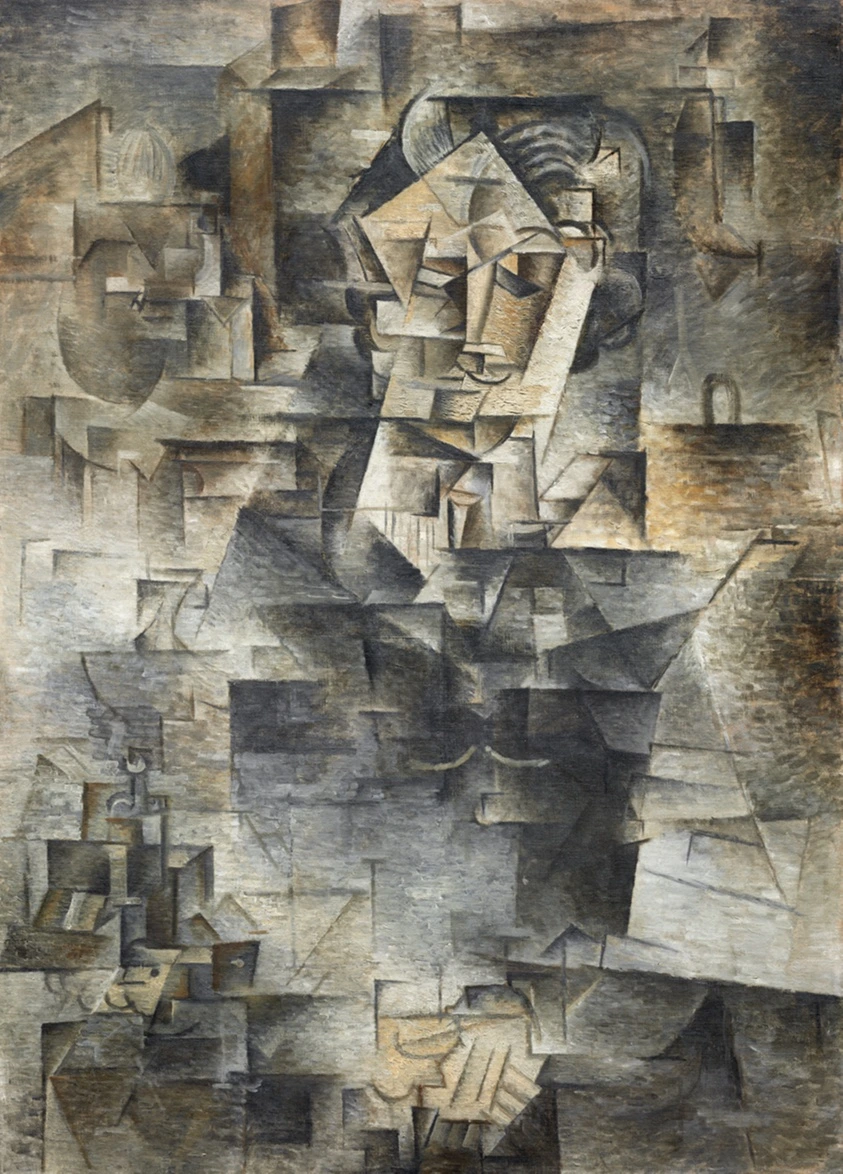
Pablo Picasso's Man with a Clarinet (1911) is a fabricated black chalk drawing on cream wove paper from the height of Analytic Cubism. This drawing shows a figure with a clarinet, rendered in the fragmented, faceted style characteristic of Analytic Cubism. The forms are broken down into geometric planes, the space flattened and ambiguous. This work belongs to the most radical phase of Cubism, when Picasso and Braque were pushing the movement to its limits.
Cultural Impact
Picasso's Analytic Cubist works of 1911 represent the most radical phase of the Cubist revolution.
Why It Matters
This Cubist drawing of a man with a clarinet shows the fragmented, faceted style of Analytic Cubism at its most radical.