Provenance
Galerie Kahnweiler, Paris, probably acquired directly from the artist [Archive photograph 260 cited in Daix 1979]; sold, Hôtel Drouot, Paris, Nov. 17–18, 1921, 2nd Kahnweiler sequestration sale, lot 173, to Rolf de Maré (1888–1964), Hildesborg, Sweden and Paris [Daix 1979]. Claire B. Zeisler (1903–1991), Chicago by 1968 [Chicago 1968]; given to the Art Institute, 1986.
Accession Number
66159
Medium
Oil on canvas
Dimensions
33 × 17.6 cm (13 × 7 in.)
Classification
Painting
Credit Line
Gift of Claire B. Zeisler in memory of A. James Speyer
Background & Context
Background Story
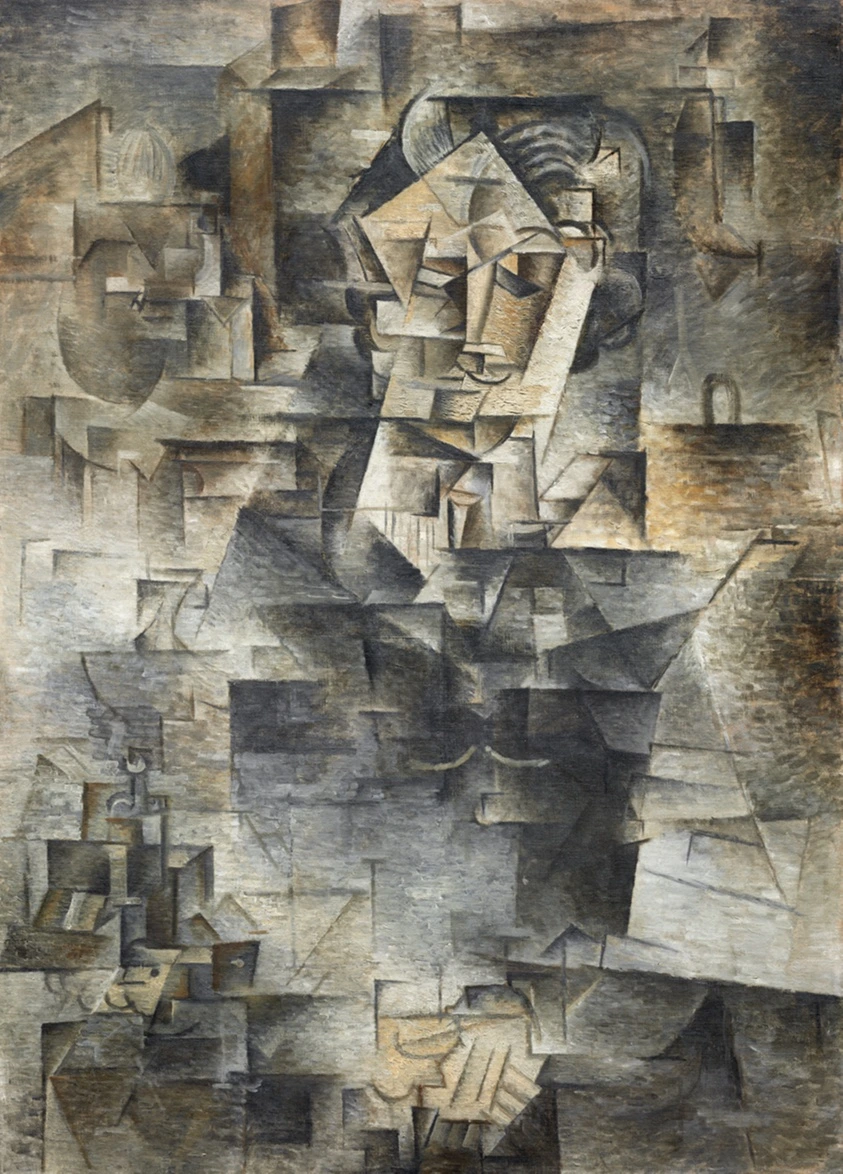
"The Glass" belongs to the most austere phase of Analytic Cubism (1910–1912), when Picasso and Braque systematically dismantled Renaissance perspective and restricted their palettes to ochre, gray, and black. The still life subject—drinking vessels, perhaps a bottle and a glass—is almost entirely dissolved into a grid of horizontal and vertical planes that shift between frontal and profile viewpoints. What survives of the original objects are not outlines but tonal gradations: a darker shape that might be the shadow of a rim, a lighter plane that might be the reflection of a window. The canvas is small (33 × 17.6 cm), suggesting that it was painted as a study rather than a finished exhibition piece, yet its concentration makes it one of the most demanding works in Picasso's entire output. The limited palette was not merely an aesthetic choice but a theoretical necessity: by suppressing color, Picasso forced the viewer to attend to form and space, the true subjects of Cubist investigation. The painting also demonstrates the influence of African sculpture and Iberian art on Picasso's spatial thinking: the compressed, shallow space of the canvas recalls the flattened volumes of carved masks, where front and side coexist on a single plane. Art historians have linked this work to the philosophical debates about perception that were circulating in Parisian intellectual circles, particularly Bergson's concept of "duration" as a continuous flow rather than a series of discrete moments. Whether or not Picasso read Bergson, "The Glass" embodies a similar temporal multiplicity, presenting the object as it might be seen over time rather than at a single instant.
Cultural Impact
This canvas epitomized high Analytic Cubism by suppressing color to force attention on form, dissolving the glass into a temporal multiplicity of shifting planes.
Why It Matters
It matters as a glass that no longer holds water—only space, shadow, and the memory of drinking.