Near Newport

Description

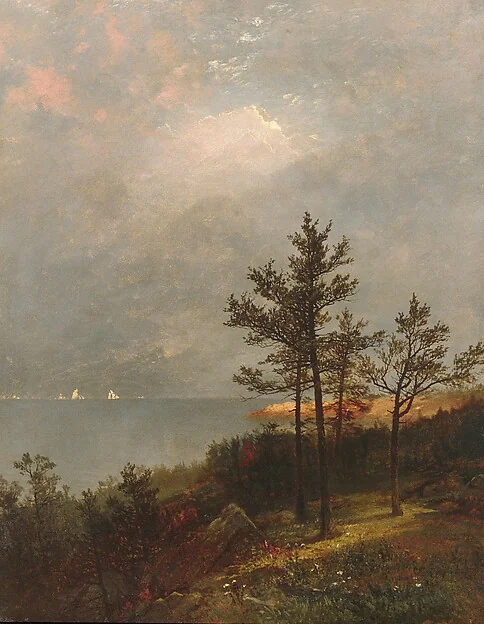
In this late work, John Frederick Kensett portrayed the Rhode Island coast with spare, yet meticulous forms suffused with light and quietude. A solitary female figure seated at right almost goes unnoticed amid the long, horizontal bands of earth and water. It is the expansive sky that dominates the composition, suggestive of a spiritual force in nature. Kensett, who first trained as an engraver, applied draftsman’s precision to his paintings of the American landscape. Near Newport hints at the tourist activities that would come to define the town in the late 19th century, with couples walking along the distant shore and bathing tents dotting the horizon.

Provenance

John F. Kensett, New York, 1869. Robert Somerville, New York, 1873; Richard Lawrence Schieffelin, New York, 1873. A. F. Mondschein, New York, by 1944; sold to the Art Institute of Chicago 1949.

Near Newport

John Frederick Kensett

1869

Accession Number

109228

Medium

Oil on canvas

Dimensions

29.5 × 62.4 cm (11 5/8 × 24 1/4 in.)

Classification

Painting

Museum

The Art Institute of Chicago

Chicago, United States

Credit Line

Friends of American Art Collection; Goodman Fund
Background & Context

Background Story

John Frederick Kensetts Near Newport from 1869 is an oil painting that exemplifies the artists mature luminist style, in which the effects of light and atmosphere on the American coastline are rendered with a transparency and quietude that distinguish his work from the more dramatic landscapes of his Hudson River School colleagues. Kensett, who spent his summers painting on the Rhode Island coast near Newport, developed a style of landscape painting that stripped away the theatrical effects of Church and Bierstadt in favor of a more meditative approach in which light itself becomes the primary subject. In Near Newport, the shoreline is reduced to a few essential horizontal elements: the beach, the water, and the sky, each rendered in a narrow range of tonal values that produces the effect of radiant stillness that is the hallmark of luminism. The year 1869 places this painting in the final years of Kensetts career, when he was producing the spare, luminous seascapes that are now considered his masterpieces, and the painting demonstrates the radical simplification of composition and palette that he achieved in his last years. The oil on canvas medium, applied in thin glazes over a light ground, allows Kensett to create the effect of light emanating from within the painting rather than being reflected from its surface, a technique that gives his late seascapes their characteristic quality of almost supernatural transparency.

Cultural Impact

Kensetts late luminist seascapes are among the most radical paintings of the 19th century, anticipating the spare compositions and atmospheric subtlety of 20th-century minimalism. His influence on American landscape painting extended through the Tonalists and the early modernists who recognized in his work a model of restraint and directness.

Why It Matters

A luminist oil painting by Kensett depicting the Rhode Island coastline near Newport with radical compositional simplification and radiant atmospheric transparency that anticipates 20th-century minimalism.