Rocky Coast

Description

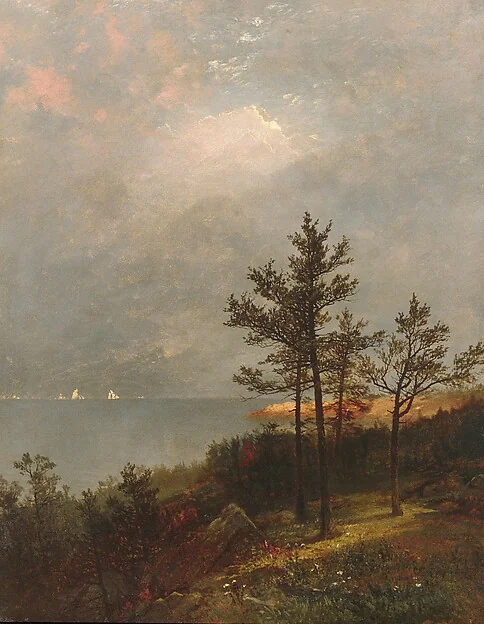
Like the Impressionists, who emphasized light effects, painters of the Hudson River School focused on temporal conditions of the landscape to suggest specific atmospheres. In Rocky Coast, John Frederick Kensett depicted the shoreline on a hazy day, with calm water and gentle waves. The careful treatment of nature by the Hudson River School artists has been linked to the writings of Transcendentalists such as Ralph Waldo Emerson, who wrote in Nature (1836): “Standing on the bare ground,—my head bathed by the blithe air, and uplifted into infinite space,—all mean egotism vanishes. I become a transparent eye-ball. I am nothing. I see all.” The horizon line of Rocky Coast illustrates this idea, as the uninterrupted water appears infinite, suggesting that the ocean continues beyond the vision of the viewer.

Rocky Coast

John Frederick Kensett

c. 1860

Accession Number

145805

Medium

Oil on canvas

Dimensions

35.6 × 61 cm (14 × 24 in.)

Classification

Painting

Museum

The Art Institute of Chicago

Chicago, United States

Credit Line

Gift of Brooks McCormick

Background & Context

Background Story

John Frederick Kensetts Rocky Coast from around 1860 is an oil painting that demonstrates the artists developing luminist style, in which the rocky shoreline of the New England coast is rendered with a clarity of light and a simplicity of composition that distinguish his work from the more detailed and dramatic landscapes of his contemporaries. The rocks of the coastline are painted with the topographic accuracy that Kensett had developed during his years of sketching from nature, but they are subordinated to the overall effect of light and atmosphere that gives the painting its luminist quality. The sky, which occupies the upper two-thirds of the composition, is rendered in thin, transparent glazes that capture the subtle gradations of color and value that occur when light passes through the atmosphere, while the water reflects the sky with a stillness that emphasizes the paintings contemplative mood rather than the more dramatic effects of waves and spray that other marine painters preferred. The date of around 1860 places this painting in the period when Kensett was transitioning from the more detailed and conventionally composed landscapes of his early career to the spare, luminous seascapes of his maturity, and Rocky Coast shows both styles operating simultaneously.

Cultural Impact

Kensetts Rocky Coast demonstrates the transition from detailed Hudson River School landscape to the spare luminist style of his maturity, a transition that would prove to be one of the most significant developments in 19th-century American landscape painting.

Why It Matters

A luminist oil painting by Kensett of a rocky New England coastline, combining topographic accuracy with atmospheric transparency in the transition from detailed landscape painting to his mature spare seascapes.