Accession Number
180666
Medium
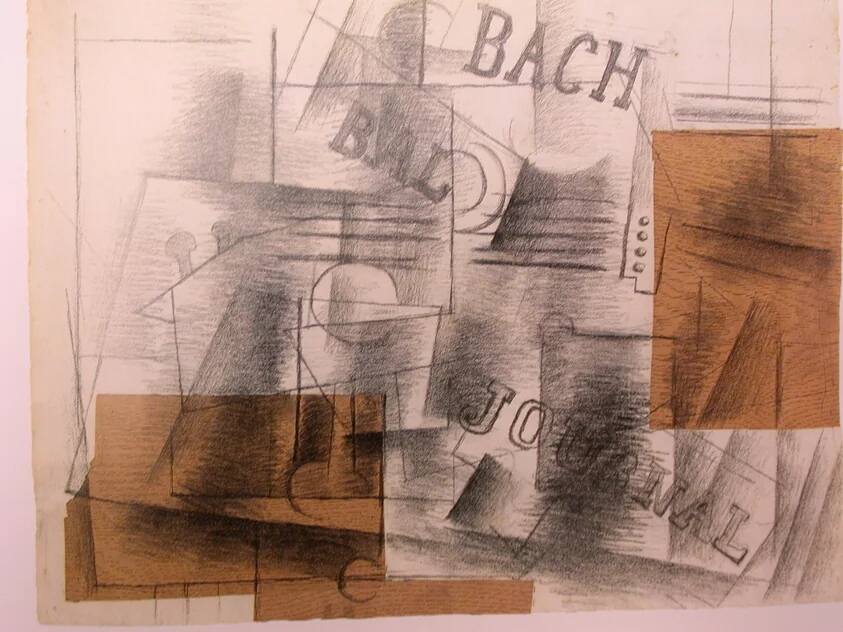
Collage composed of charcoal and cut-and-pasted commercially printed tan wove papers (recto) and charcoal (verso) on white laid paper
Dimensions
47.4 × 61.8 cm (18 11/16 × 24 3/8 in.)
Classification
drawings (visual works)
Credit Line
Gift of the Gecht Family
Background & Context
Background Story
Georges Braque's double-sided "Bal (recto); Guitar (verso)" (1912) is a collage composed of charcoal and cut-and-pasted commercially printed tan wove papers on the recto, with charcoal on the verso, on white laid paper. This early collage dates from the very beginning of the Synthetic Cubist period, when Braque and Picasso were first experimenting with the technique of incorporating printed papers (papier collé) into their work. The recto, "Bal" (Dance), uses cut papers with printed patterns to suggest the forms of a dance or musical subject. The charcoal overdrawing integrates the cut papers into the composition. The verso, "Guitar," shows the musical instrument that was a favorite motif in Cubist art. The double-sided nature of this work is particularly valuable, showing Braque exploring different subjects on the two sides of the same support. The year 1912 was the annus mirabilis of Synthetic Cubism, when the invention of collage transformed the possibilities of modern art.
Cultural Impact
Braque's papiers collés of 1912 were a watershed in modern art, introducing the technique of collage that would influence virtually every subsequent development in 20th-century art.
Why It Matters
This double-sided collage from 1912 captures the excitement of the early Cubist experiments with papier collé, the cut papers and charcoal creating a new kind of visual experience that changed the course of modern art.


