Accession Number
20565
Medium
Etching with aquatint in two colors on paper
Dimensions
Plate: 20.8 × 16 cm (8 1/4 × 6 5/16 in.); Sheet: 57 × 45 cm (22 1/2 × 17 3/4 in.)
Classification
etching
Credit Line
Gift of Mrs. Edith G. Halpert
Background & Context
Background Story
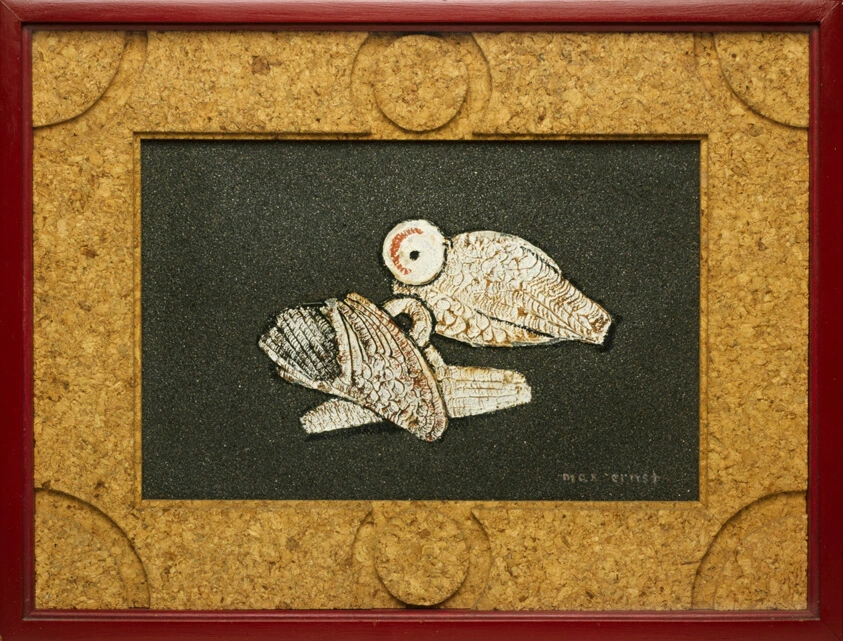
"Hommage a Rimbaud" is one of Max Ernst's most poetically resonant etchings, executed in 1961 during the period when the German Surrealist was living in France and producing a series of prints that paid tribute to the writers and artists who had shaped his imaginative world. The image is an etching with aquatint in two colors, the composition showing abstract or biomorphic forms that suggest the visionary landscapes of Rimbaud's poetry without illustrating any specific text. The aquatint technique creates granular tonal fields that evoke the dreamlike atmosphere of Ernst's most famous paintings, while the etched lines provide the calligraphic energy that connects his work to the automatic drawings of his Surrealist period. The title pays homage to Arthur Rimbaud, the nineteenth-century French poet whose "Season in Hell" and "Illuminations" had provided a template for the artist as seer, the creator who transforms reality through the power of the imagination. Ernst's identification with Rimbaud was deep and lifelong: both were rebels against bourgeois society, both sought in art a transcendence of ordinary consciousness, and both suffered exile and misunderstanding in pursuit of their visions. The two-color printing—probably black and a warm brown or ochre—creates a chromatic subtlety that makes the image feel aged and timeless, as if it had been discovered in an old book rather than produced in a modern atelier. Art historians have connected this print to the broader tradition of the livre d'artiste in France, the deluxe artist's book that had flourished since the nineteenth century and that Ernst contributed to throughout his career. The work also reflects Ernst's technical mastery in his sixties: he had been making prints since the 1920s, and the confidence of the etching demonstrates decades of experimentation with intaglio processes.
Cultural Impact
This 1961 aquatint etching paid Surrealist homage to Rimbaud's visionary rebellion, using two-color tonal fields to make modern printmaking feel like a discovery from an old book of prophecies.
Why It Matters
It matters because Ernst drew a dream for a dead poet and made the acid bite like verse—proving that even metal could remember what language had already forgotten.