Accession Number
27370
Medium
Color etching and aquatint on laid ivory paper
Dimensions
Plate: 23.2 × 17.6 cm (9 3/16 × 6 15/16 in.); Sheet: 48 × 33.2 cm (18 15/16 × 13 1/8 in.)
Classification
etching
Credit Line
Harold Joachim Purchase Fund
Background & Context
Background Story
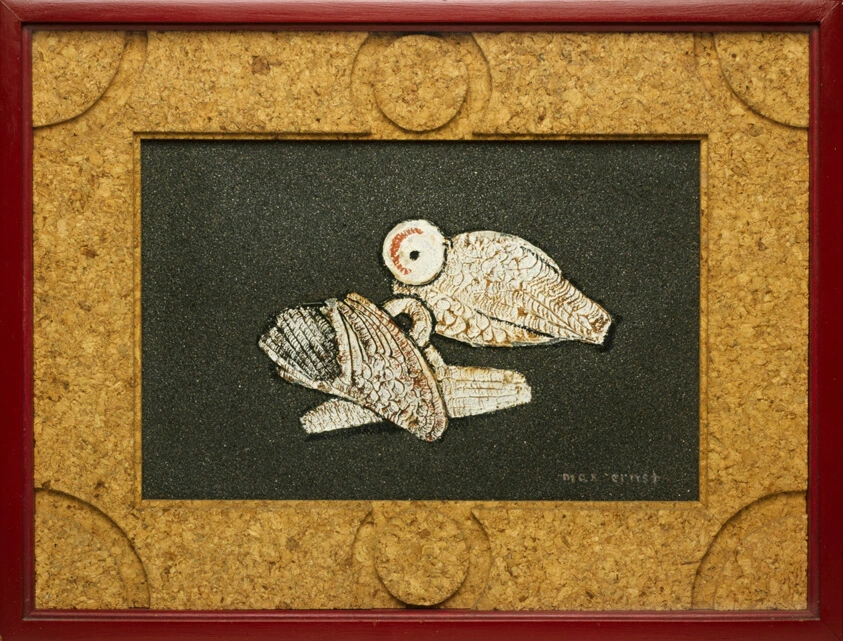
"Personnages" is a 1952 color etching and aquatint that captures Max Ernst at the height of his postwar printmaking activity, when he was producing a series of prints in color that expanded the tonal possibilities of the Surrealist image beyond the black-and-white conventions of his earlier work. The composition shows figures—"personnages"—that are barely distinguishable from the surrounding space, their biomorphic forms emerging from and dissolving into the aquatint tonalities with the fluidity that characterized Ernst's mature abstraction. The color is restrained but effective: probably earth tones and muted primaries that suggest a natural world seen through the distorting lens of dream. The 1952 date places this work in the period when Ernst had returned to Paris after his American exile, rejoining the Surrealist circle around André Breton and resuming the European career that the war had interrupted. The print also reflects the influence of his second wife, Dorothea Tanning, an American painter whose own work was increasingly abstract during this period and whose artistic dialogue with Ernst enriched both their practices. The technique of color etching and aquatint was relatively new for Ernst: he had experimented with it in the 1930s but developed it more systematically after the war, when access to better printing facilities and collaborations with master printers like Georges Visat allowed more ambitious projects. Art historians have connected these color prints to Ernst's contemporaneous paintings, noting that the same biomorphic vocabulary appears in both media, suggesting a unified vision that transcended the limitations of any single technique. The work also documents the institutionalization of Surrealism in the 1950s: what had been a radical avant-garde movement in the 1920s was now an established style with a market, a history, and a museum presence.
Cultural Impact
This 1952 color etching marked Ernst's postwar return to Parisian Surrealism, using earth-toned aquatint to expand biomorphic abstraction beyond black-and-white conventions through printmaking sophistication.
Why It Matters
It matters because Ernst made figures that were almost places and places that were almost people—proving that Surrealism could keep dreaming even after the world had stopped.