Accession Number
27375
Medium
Etching and aquatint on white wove paper
Dimensions
Plate: 23.6 × 17.8 cm (9 5/16 × 7 1/16 in.); Sheet: 32.8 × 25 cm (12 15/16 × 9 7/8 in.)
Classification
lithograph
Credit Line
Harold Joachim Purchase Fund
Background & Context
Background Story
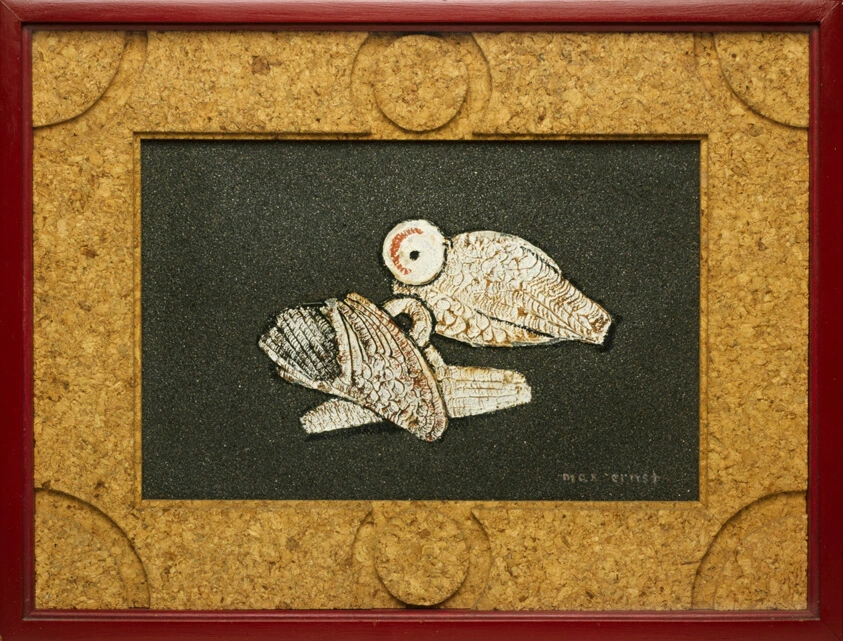
"Figure" is a 1950 etching and aquatint that represents Max Ernst's ongoing exploration of the single figure as a vehicle for psychological and formal investigation, the solitary form emerging from the tonal ground like a fossil or a memory half-recalled from sleep. The composition is centered and frontal, the figure occupying the middle of the plate with a presence that is simultaneously monumental and fragile, the aquatint creating a misty atmosphere that threatens to dissolve the form even as the etched lines assert its physical existence. The 1950 date places this work in the period of transition between Ernst's American and European careers, when he was living in Arizona with Dorothea Tanning and producing some of his most lyrical desert-inspired works before returning to France. The title—simply "Figure"—is typical of Ernst's reluctance to specify meaning: he preferred to let the image speak for itself, to invite the viewer's projection rather than constrain interpretation with narrative detail. The white wove paper provides a bright, neutral ground that makes the tonal gradations of the aquatint appear subtle and refined, a technical achievement that demonstrates Ernst's growing mastery of the print medium. Art historians have connected this print to the broader postwar revival of figurative abstraction, particularly in Europe where artists like Picasso, Giacometti, and Wols were exploring the human form as a vehicle for existential anxiety. Ernst's figure is less anguished than Giacometti's, more playful than Wols's, suggesting that Surrealism offered a way to engage with the postwar crisis without abandoning the imaginative freedom that had defined the movement from its origins.
Cultural Impact
This 1950 Arizona-period etching explored solitary figure-as-memory through refined aquatint mist, bridging American desert lyricism with European existential abstraction in postwar transition.
Why It Matters
It matters because Ernst drew one person alone and made the paper hold its breath—proving that even a single figure could contain a whole desert of uncertainty.