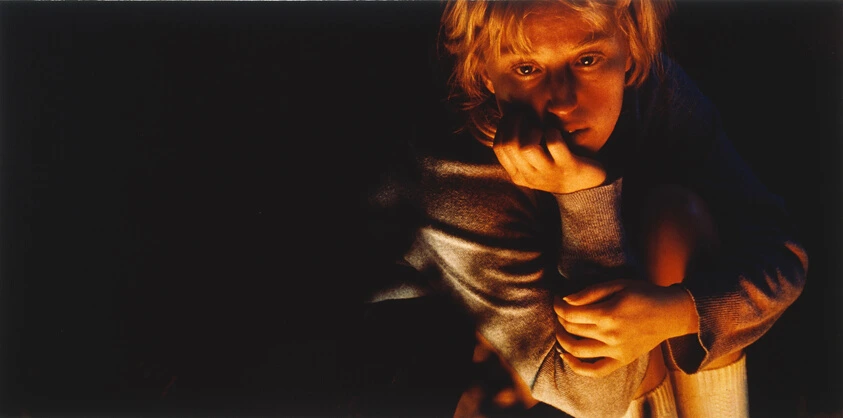
Untitled #88

Description

Cindy Sherman’s staged photographs explore the pervasive effects of mass-media images on individual identities. Since the late 1970s, the artist has served as both photographer and model for a large cast of fictional personalities created primarily through costume, hair, makeup, and lighting. In 1981 she began a series of large color photographs that mimic the horizontal format of a magazine centerfold. Critiques of these glossy spreads, Sherman’s representations are fraught with anxiety, vulnerability, and longing. In Untitled #88, she depicted herself as a young, disheveled blonde girl; her fragility and isolation are underscored by her huddled body language and pensive stare. An imposing darkness surrounds her, except for the warm glow from what is most likely a fire, the only source of light in the picture. While the girl’s specific situation remains ambiguous, the photograph illustrates that, for Sherman, gender roles are performative.

Untitled #88

Cindy Sherman

1981

Accession Number

110634

Medium

Chromogenic print; artist's proof number one of one

Dimensions

61 × 121.9 cm (24 × 48 in.)

Classification

silver-dye bleach print

Museum

The Art Institute of Chicago

Chicago, United States

Credit Line

Gerald S. Elliott Fund in memory of Ann Elliott

Background & Context

Background Story

"Untitled #88" is a 1981 chromogenic print by Cindy Sherman that demonstrates the American artist's mastery of the photographic self-performance during the period of her most influential work, the image showing another variation on the "Untitled Film Still" theme with the same technical precision and conceptual rigor that characterizes the series. The composition is a 24 × 48 inch print, the artist's proof suggesting that this image was part of the same production sequence as the editioned prints, the trial proof serving as a document of the experimental process that produced the finished work. The chromogenic print creates a surface of extraordinary color saturation and tonal range, the technical qualities of the medium serving both the aesthetic pleasure of the image and the critical project of exposing the construction of cinematic femininity. The 1981 date places this work in the same year as the other "Untitled Film Stills," suggesting that Sherman was working intensively on the series, producing multiple variations that explored the full range of Hollywood stereotypes and their deconstruction. Art historians have connected this print to the broader tradition of the artist's proof in photography, from the experimental prints of Man Ray to the working prints of Diane Arbus, noting that Sherman's treatment of the proof as an independent work reflects both the commercial nature of photographic production and the conceptual interest in process and documentation that characterized postmodern art. The work also demonstrates Sherman's influence on the development of identity politics in art: the exploration of gender as a performance rather than an essence provided a model for artists who sought to deconstruct the naturalized categories of race, class, and sexuality.

Cultural Impact

This 1981 artist's proof made photographic process commercially conceptual through chromogenic color-saturation trial-print documentation, using 24×48-inch stereotype variation to provide identity-politics performance-model beyond gender essence naturalization.

Why It Matters

It matters because Sherman made a proof of herself and made the paper feel like it was still deciding who to be—proving that even a test print could be a masterpiece if the question was honest enough.