Accession Number
129490
Medium
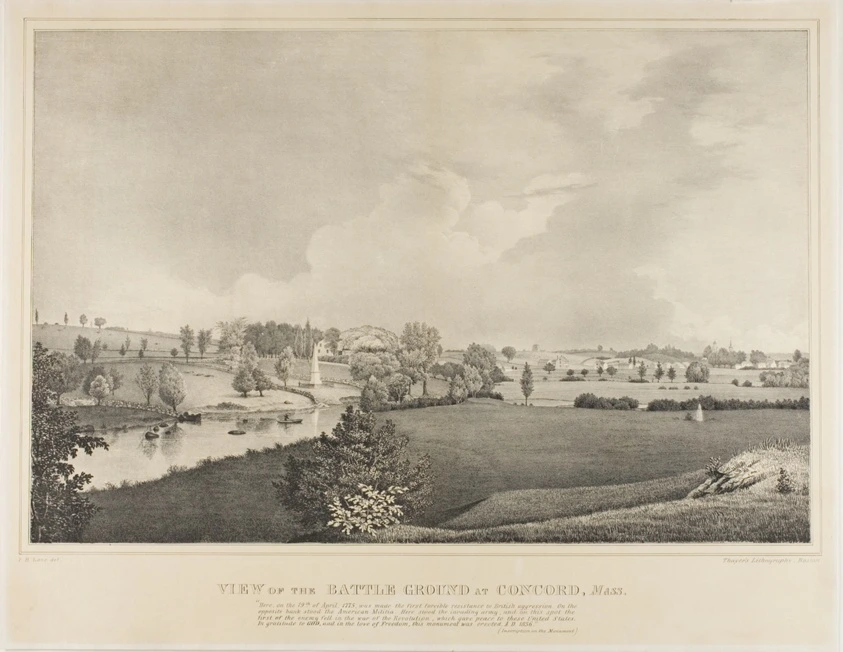
Lithograph on wove paper
Dimensions
Image: 32.8 × 49.9 cm (12 15/16 × 19 11/16 in.); Sheet: 40.8 × 51 cm (16 1/8 × 20 1/8 in.)
Classification
lithograph
Credit Line
Gift of Dorothy Braude Edinburg to the Harry B. and Bessie K. Braude Memorial Collection
Background & Context
Background Story
"View of the Town of Gloucester, Massachusetts" is a c. 1836 lithograph by Fitz Henry Lane that captures the American Luminist painter in his most topographically precise and atmospherically serene mode, the image showing the Massachusetts port town rendered with the same crystalline clarity and luminous stillness that made Lane the defining master of American marine painting. The composition is a medium-sized lithograph—image 32.8 × 49.9 centimeters—showing Gloucester with the lithograph on wove paper creating a surface of extraordinary precision and atmospheric depth. The lithograph technique creates subtle tonal variations that suggest both the physical reality of the town and the shimmering quality of the coastal light. The c. 1836 date places this work in the early period of Lane's mature career, when he was producing the lithographs and paintings that documented the New England coast and established his reputation as the leading American marine artist. Art historians have connected this print to the broader tradition of the town view in American art, from the prints of the period to the paintings of the Hudson River School, noting that Lane's treatment is more focused on the atmospheric stillness and the crystalline clarity, the transformation of observed reality into luminous vision, than the topographical accuracy or the social observation of these other traditions.
Cultural Impact
This c. 1836 lithograph made Gloucester luminously precise through medium 32cm crystalline town-view clarity and atmospheric coastal shimmer, using early mature marine career to transform Massachusetts port into serene luminous vision beyond Hudson River School topographical social observation.
Why It Matters
It matters because Lane printed a town and made the paper feel like it was holding its breath in the morning harbor mist—proving that even a port could be a prayer if the lithography was still enough.