Provenance
Galerie Kahnweiler, probably acquired directly from the artist [Kahnweiler photo no. 1184; Isarlov 1932]. Sold, to Jacques M. Netter, Paris, Hôtel Drouot, Kahnweiler sequestration sale, Nov. 17–18, 1921, lot 32. Jacques Douçet (died 1929), Neuilly-sur-Seine, by 1928 [photograph probably taken by Pierre Legrain, 1928, copy in curatorial file]; by descent to his wife Mme. Douçet; sold to Jacques Seligmann and Company, Sept. 15, 1937 [receipt, Seligmann Records, Archives of American Art, Smithsonian Institution, Washington, D.C.]; sold to Mima de Manziarly Porter, Chicago and New York, Nov. 2, 1937 [Porter Estate document, c. 1938–49, in curatorial file]; bequeathed to the Art Institute, 1989.
Accession Number
73643
Medium
Oil on canvas mounted on hardboard
Dimensions
34.6 × 23.8 cm (13 5/8 × 9 3/8 in.)
Classification
oil on canvas
Credit Line
Bequest of Mima de Manziarly Porter
Background & Context
Background Story
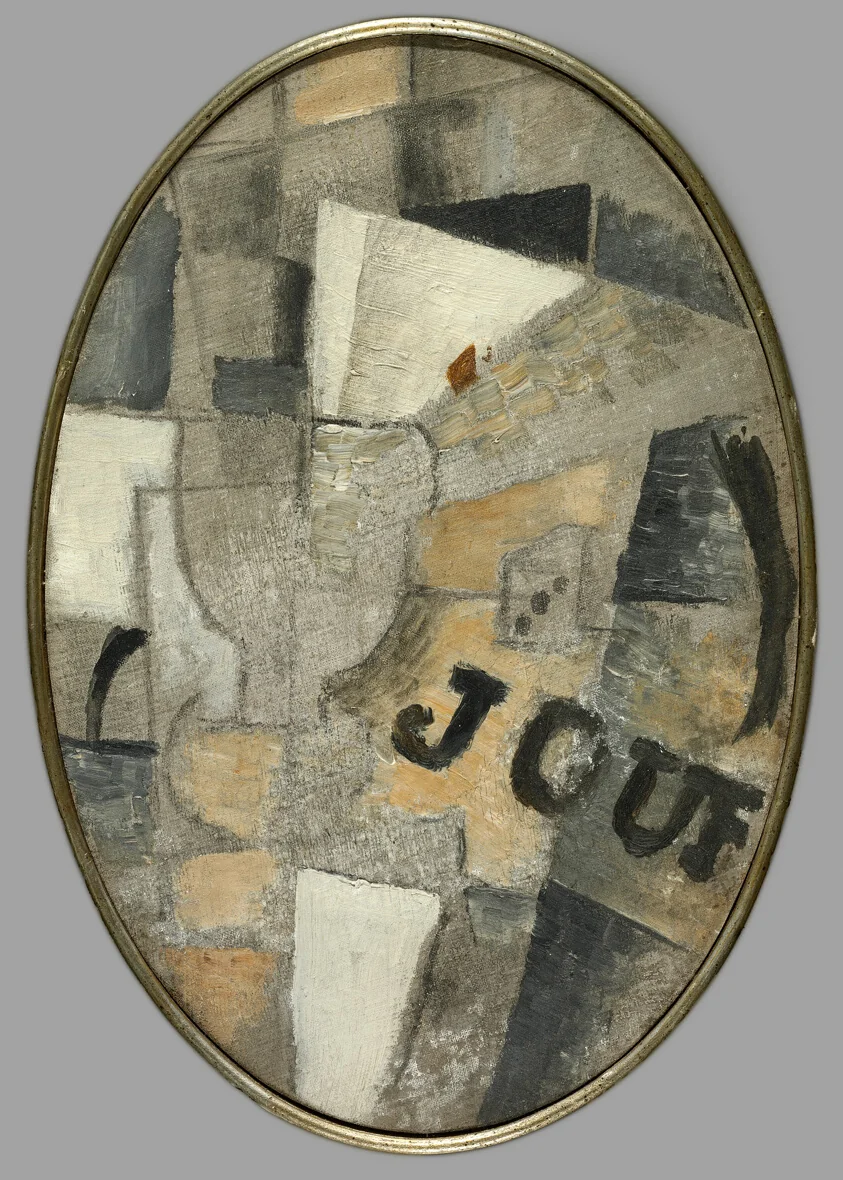
Georges Braque's "Still Life with Glass, Dice, Newspaper and Playing Card" (1913) is an oil on canvas mounted on hardboard, from the height of the Synthetic Cubist period. The composition brings together the characteristic elements of Cubist still life: a glass, dice, a newspaper (the quotidian journal that was a favorite Cubist motif), and a playing card. These objects are arranged on a tabletop, their forms broken down and reassembled according to Cubist principles. The palette is richer than the muted earth tones of Analytical Cubism, with areas of brighter color that announce the more decorative phase of the movement. The oil on canvas technique is supplemented by the illusion of texture and pattern that Cubist painters achieved through varied brushwork. The playing card, with its flat, graphic quality, was a particularly apt subject for Synthetic Cubism, which increasingly emphasized the two-dimensional surface of the painting. This still life is a masterpiece of the Synthetic Cubist period, demonstrating the movement's transformation from analysis to synthesis.
Cultural Impact
Braque's paintings of playing cards, dice, and newspapers epitomize the Synthetic Cubist fascination with the objects of everyday life and the visual culture of the modern city.
Why It Matters
This still life from the height of Synthetic Cubism transforms ordinary objects—a glass, dice, a newspaper, a playing card—into a composition of extraordinary formal complexity and beauty.


