Provenance
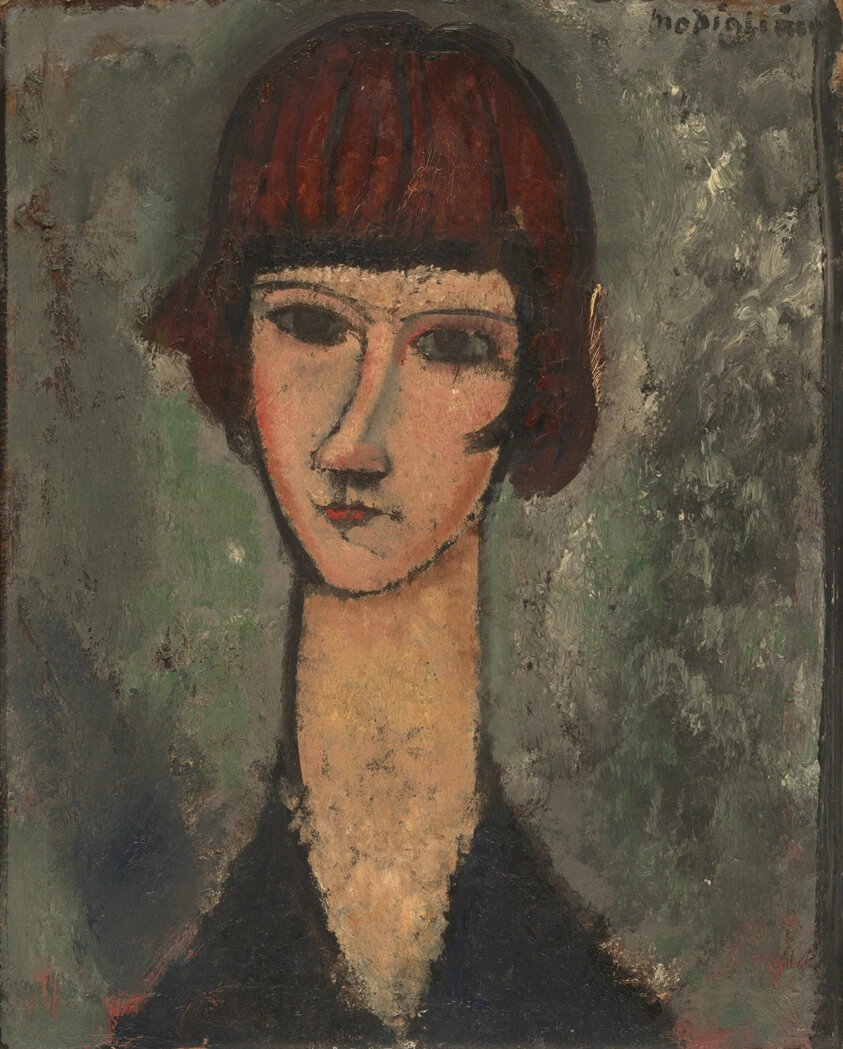
Galerie Zborowski, Paris, probably acquired directly from the artist. Bernheim Jeune, Paris, before 1929 [Pfannstiel, 1929]. Reinhardt Galleries, New York, by 1936 [this and the following according to Winterbotham Collection inventory, Oct. 2, 1936, copy in curatorial file]; sold to Joseph Winterbotham, Jr. (1878–1954), Chicago and Burlington, Vt., by Oct. 2, 1936; bequeathed to the Art Institute, 1954.
Accession Number
80586
Medium
Oil on cardboard
Dimensions
55.9 × 45.4 cm (22 × 17 7/8 in.)
Classification
Painting
Credit Line
Bequest of Joseph Winterbotham
Background & Context
Background Story
Portrait of a Woman from c. 1917-19 is a characteristic Modigliani portrait, depicting an unidentified woman with the elongated face, simplified features, and mask-like blank eyes that define his portrait style. The oil on cardboard format was one that Modigliani used frequently during his most productive period—it was cheaper than canvas and allowed him to work rapidly, producing the series of portraits that filled his studio during the war years. The c. 1917-19 date places this in the period when Modigliani was painting the portraits of friends, lovers, and fellow artists that are now his most celebrated works.
Cultural Impact
Modigliani's portraits of unidentified women are among the most recognizable images in 20th-century art because they combine the elongated style of his signature manner with a psychological intensity that transcends individual likeness. Portrait of a Woman is not a portrait of a specific person so much as a meditation on the act of portraiture itself—the blank eyes staring out at the viewer suggest that the portrait is an engagement between artist and viewer rather than a record of a specific sitter.
Why It Matters
Portrait of a Woman is Modigliani's signature style at its most distilled: the elongated face, simplified features, and mask-like blank eyes that make his portraits instantly recognizable. The c. 1917-19 portrait is not a record of a specific person but a meditation on portraiture itself—an engagement between artist and viewer through the mask of the elongated face.