
Accession Number
95699
Medium
Pen and brown ink on brown laid paper, tipped onto cream laid paper
Dimensions
11.8 × 25 cm (4 11/16 × 9 7/8 in.)
Classification
pen and ink drawings
Credit Line
The Leonora Hall Gurley Memorial Collection
Background & Context
Background Story
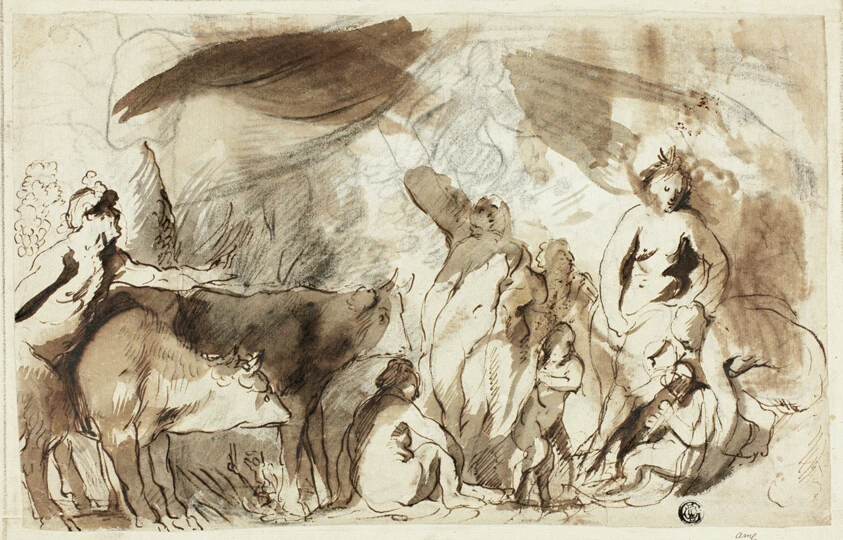
Berninis Fountain Figures is a pen and brown ink drawing on brown laid paper that depicts figures designed for one of the sculptors many fountain projects, which were among the most visible and celebrated commissions of Baroque Rome. The brown ink on brown paper creates an overall tonal warmth that gives the figures a sculptural presence despite the limitations of the monochrome medium, and the absence of wash or chalk suggests that this is a compositional study focused on the arrangement and gesture of the figures rather than their tonal modeling. Bernini designed or contributed to several of Romes most famous fountains, including the Fountain of the Four Rivers in Piazza Navona and the Fountain of the Triton in Piazza Barberini, and his fountain figures are characterized by the dynamic poses and expressive gestures that distinguish his sculptural work from the more static approach of his contemporaries. The pen and ink line is rapid and calligraphic, with the speed and confidence of an artist who thinks in three dimensions and uses drawing as a quick language for working out compositional ideas rather than as a finished work in itself. The brown ink on brown paper was a common combination in 17th-century Italian drawing practice, providing a warm middle tone that reduces the value range available to the draftsman and requires greater reliance on line quality and compositional clarity to create the illusion of three-dimensional form.
Cultural Impact
Berninis fountain designs transformed public space in Baroque Rome and established a model for public fountain sculpture throughout Europe. His drawings for fountain figures are key documents for understanding how the greatest sculptor of the period conceived of three-dimensional form in two dimensions, and how drawing functioned as a language for sculptural thinking.
Why It Matters
A compositional pen and ink drawing by Bernini for fountain figures, using rapid calligraphic line on brown paper to work out the dynamic poses and gestures characteristic of his fountain sculptures, revealing drawing as a language for sculptural thinking.
Related Artworks

Putti Carrying the Cross (recto); Studies of a Hand (verso)
Gian Lorenzo Bernini

Study after Bernini's Angel sculpture at Ponte Sant'Angelo (recto); Copy of Africa Group (verso)
Gian Lorenzo Bernini
Study for the Sine Baccho et Cerere Friget Venus (recto); Family of Darius before Alexander (verso)
Jacob Jordaens

Artist, Palette and Donkey II
Marc Chagall