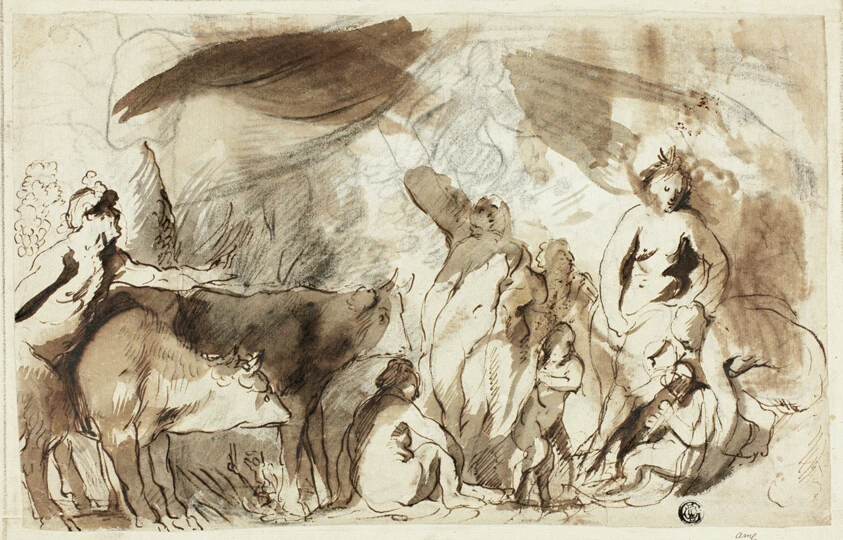
Study for the Sine Baccho et Cerere Friget Venus (recto); Family of Darius before Alexander (verso)
n.d.
Accession Number
112380
Medium
Pen and black ink with brush and brown wash, over black chalk (recto), and brush and brown wash over black chalk (verso), on ivory laid paper
Dimensions
20.5 × 32.4 cm (8 1/8 × 12 13/16 in.)
Classification
pen and ink drawings
Credit Line
The Leonora Hall Gurley Memorial Collection
Background & Context
Background Story
This double-sided drawing by Jacob Jordaens consists of a Study for the Sine Baccho et Cerere Friget Venus on the recto and a Family of Darius before Alexander on the verso, two compositional studies that reveal the working process of the most important painter in Antwerp after Rubens. The recto study relates to Jordaenss series of paintings on the theme Without Bacchus and Ceres, Venus Freezes, a proverb derived from the Latin saying that without wine and bread, love grows cold, which the artist treated in multiple versions throughout his career. The subject allowed Jordaens to combine his skill in depicting revelry and physical abundance with a moralizing message about the interdependence of sustenance, intoxication, and desire, a combination that suited his talent for robust figure painting and his interest in the pleasures and consequences of excess. The verso depicts the story from Plutarch of the Family of Darius before Alexander, a subject that Jordaens treated in at least one known painting, in which the defeated Persian kings family kneels before Alexander the Great in a scene of nobility and mercy that resonated with Baroque audiences as a model of enlightened rulership. The pen and ink with brown wash over black chalk on both sides reveals Jordaens working method: the black chalk establishes the composition, the pen provides contour and detail, and the brush and wash create atmospheric shadow and volume. The two studies on a single sheet represent two very different subjects, a genre scene of sensual abundance and a history painting of martial virtue, that demonstrate the range of Jordaens artistic interests.
Cultural Impact
Jordaens double-sided drawings are invaluable documents for understanding the working methods of the leading Antwerp painter of the mid-17th century, revealing how compositional ideas were developed, revised, and sometimes discarded. The combination of a genre subject and a history painting on a single sheet demonstrates the range that made Jordaens the dominant painter in Antwerp after Rubens.
Why It Matters
A double-sided compositional drawing by Jordaens with a revelry study on the recto and a history painting study on the verso, revealing the pen, ink, and wash working process of Antwerps leading Baroque painter and the range from genre sensuality to martial virtue that defined his career.