Description
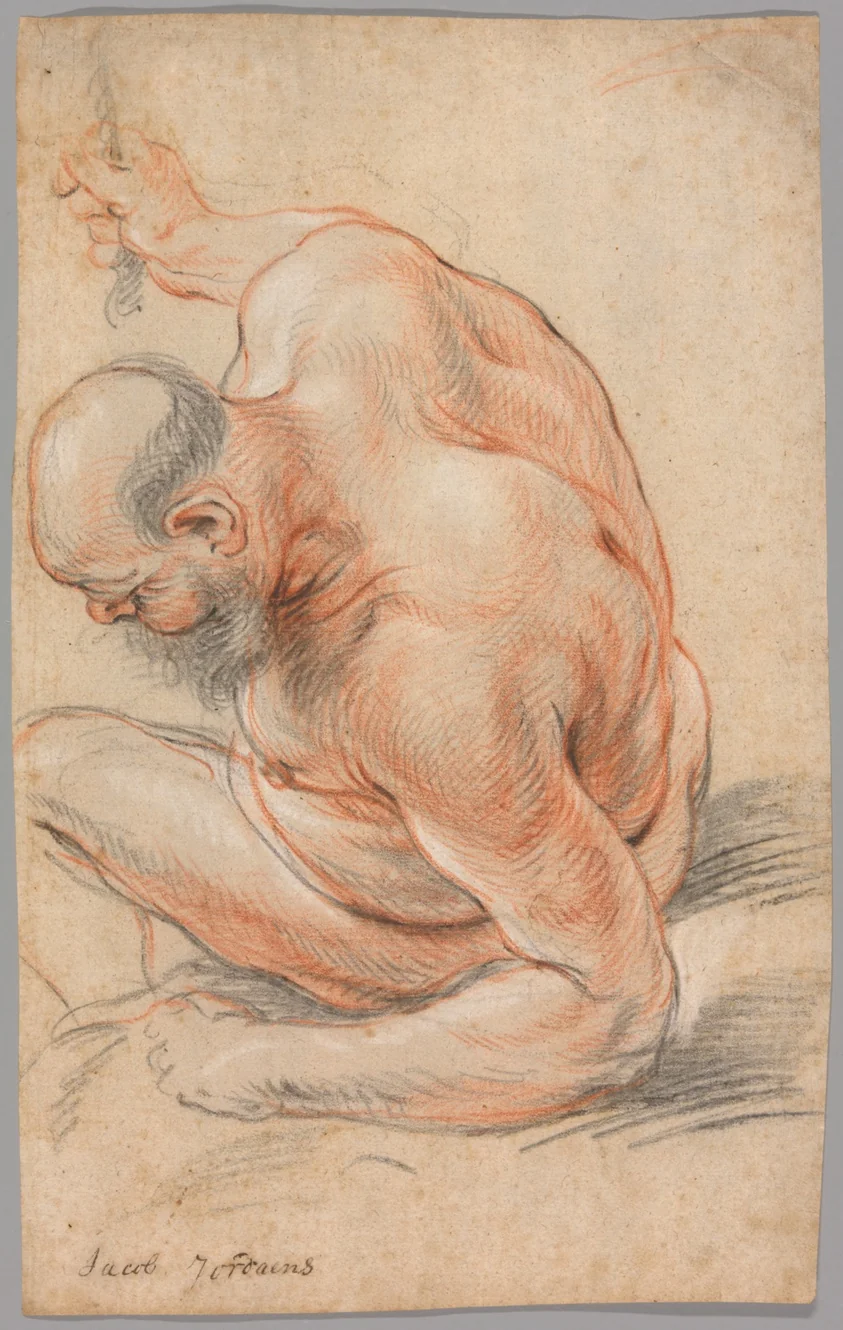
Following Rubens's death in 1640, Jordaens was regarded as the greatest living painter in the Southern Netherlands. Deeply influenced by Rubens, Jordaens created genre scenes characterized by an often candid realism. This study from life depicts a figure familiar from other drawings and paintings by the artist from around 1640.
Provenance
Art Gallery of Jean Willems, Brussels, by 1966. Sold by A. De Heuvel, Brussels, to Professor and Mrs. Roger Adolf d’Hulst, Dilbeek, Belgium, 1966; sold to the Art Institute of Chicago, 1990.
Accession Number
76291
Medium
Red and black chalk, with touches of white chalk, on cream laid paper
Dimensions
34.4 × 21.7 cm (13 9/16 × 8 9/16 in.)
Classification
chalk
Credit Line
Purchased with funds provided by Mrs. George B. Young; Helen Regenstein and H. Karl and Nancy von Maltitz Endowments
Background & Context
Background Story
"Nude Old Man Seated, Leaning on His Forearm, Facing Left" is a c. 1640 drawing by Jacob Jordaens that captures the Flemish Baroque master in his most observational and anatomically precise mode, the image showing an elderly nude rendered with the same robust physicality and honest observation that characterized his most powerful figure studies. The composition is a medium-sized drawing—34.4 × 21.7 centimeters—showing an old man seated in repose with the red and black chalk and touches of white chalk on cream laid paper creating a surface of extraordinary warmth and anatomical precision. The chalk technique creates bold, expressive marks that suggest both the physical weight of the aged body and the structural integrity of the underlying anatomy, while the white chalk highlights add points of brilliance that suggest the studio light and the sculptural form. The cream laid paper provides a warm, sympathetic ground that makes the chalk colors appear rich and substantial. The c. 1640 date places this work in the period of Jordaens's mature career, when he was producing the drawings and paintings that documented the full range of human types and physical conditions. Art historians have connected this drawing to the broader tradition of the academy study in Baroque art, from the drawings of Rubens to the studies of the French academicians, noting that Jordaens's treatment is more focused on the honest observation and the robust physicality, the transformation of aged body into anatomical testament, than the idealized beauty or the classical perfection of these other traditions.
Cultural Impact
This c. 1640 chalk drawing made aged body anatomically honest through medium 34cm robust expressive red-black-white chalk marks and cream-paper sculptural warmth, using mature career to transform elderly nude into structural anatomy testament beyond French academy classical perfection.
Why It Matters
It matters because Jordaens drew an old man naked and made the paper feel like it was respecting every bone and sag—proving that even age could be dignity if the chalk was honest enough.