Provenance
Claudine Bouzonnet-Stella (the artist’s niece); by descent to Michel de Masso. Gaetano Minossi Romano, by 1756. Thomas Talbot of Margam (1747-1806) [according to London 1986 auc. cat.]. Possibly Lady Blythswood (died 1958); by descent toher grandson, Christopher Methuen-Campbell (died 1998). Sold, Christie’s, London, Dec. 9, 1986, lot 127, to Dorothy Braude Edinburg, Brookline, MA.; given to the Art Institute of Chicago, 2013.
Accession Number
151458
Medium
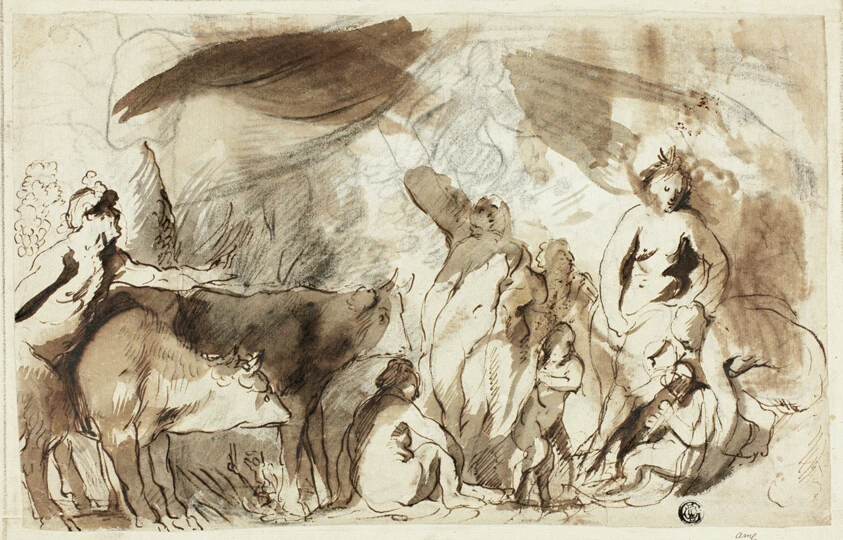
Pen and black ink, with brush and gray and pale brown wash and graphite, on pieced cream laid paper (two figures before column are cut from a similar paper and inserted over a slightly smaller hole in the primary support)
Dimensions
36.7 × 26.7 cm (14 1/2 × 10 9/16 in.)
Classification
pen and ink drawings
Credit Line
Gift of Dorothy Braude Edinburg to the Harry B. and Bessie K. Braude Memorial Collection
Background & Context
Background Story
Jacques Stellas Marriage of the Virgin from around 1640 is a pen and ink drawing with gray and pale brown wash on pieced cream laid paper that depicts the biblical story of the marriage of Mary and Joseph, a subject that allowed Stella to demonstrate his mastery of multi-figure composition and architectural setting within the classical tradition. The marriage of the Virgin, in which the high priest joins Mary and Joseph in matrimony while Josephs flowering rod identifies him as Gods chosen husband for Mary, is a subject with a long iconographic tradition that Stella treats with the clarity and elegance that distinguish his paintings from the more dramatic Baroque treatments of the same subject by his Italian contemporaries. The drawing is notable for its pieced construction, in which two figures before a column are cut from a similar paper and inserted over a slightly smaller hole in the primary support, a physical alteration that reveals Stellas revision of the composition during the drawing process and provides a rare glimpse of the artists working method. The pen and black ink provides the contour and detail, the gray and pale brown washes create atmospheric depth and volume, and the graphite underdrawing establishes the compositional framework, revealing a systematic working process in which the drawing was built up through successive layers of media. The year 1640 places this drawing in the period of Stellas most productive engagement with religious subject matter, when he was producing paintings and drawings for churches and private collectors in Paris.
Cultural Impact
Stella Marriage of the Virgin drawing demonstrates the systematic compositional process of a key figure in 17th-century French classicism, and the physical evidence of his revisions provides invaluable evidence for understanding how classical compositions were developed and refined.
Why It Matters
A compositional drawing by Stella of the Marriage of the Virgin with a rare physical revision where two figures were cut and inserted, revealing the systematic working process of French classical composition through pen, ink, and wash on pieced paper.