Human Figure with Two Birds

Description

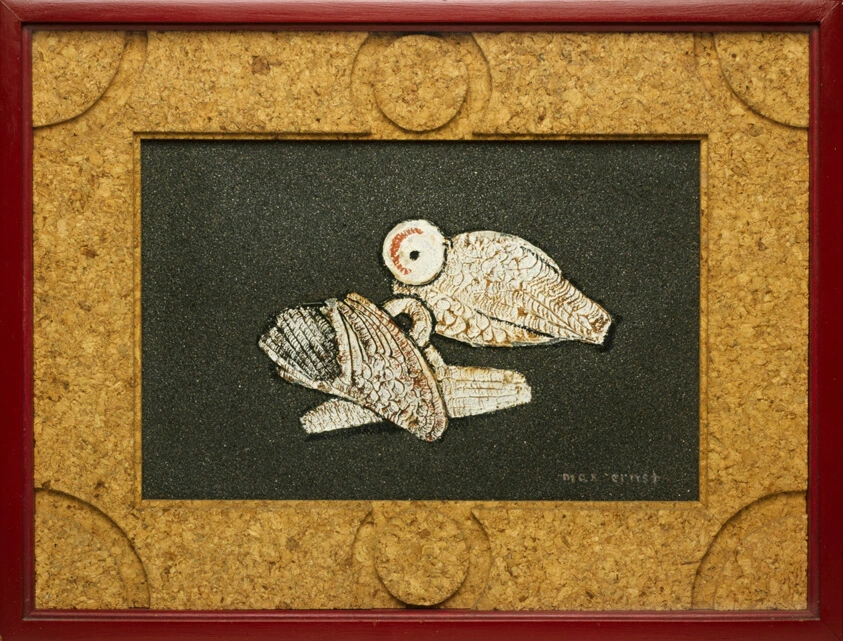
Like Constantin Brâncusi, Max Ernst was fascinated with birds, and among his earliest works incorporating this motif are some two dozen small, unconventional pictures made around 1925. One of these works was incorporated as a picture within a picture in Human Figure with Two Birds, a painting that set the stage for an extraordinary series of works that Ernst began in 1930, which featured a large, fantastic bird figure that the artist identified as Loplop. In these works, Loplop, the artist’s "private phantom attached to my person," generally holds up a picture for presentation. Here the rudimentary figure outlined in white is an early manifestation of Loplop, Ernst’s playful, surreal concept of self-portraiture by proxy.

Provenance

The artist, Paris, until at least 1938 [Brühl 1991]; Claude Hersaint (1903-1993), Paris, acquired directly from the artist [London 1984]; probably given to his wife, Hélène Anavi (1904-1982), Paris and Villeneuve, by 1960; her estate, 1982; sold, Sotheby’s, London, The Hélène Anavi Collection of Surrealist and Post-war Art, March 27, 1984, lot 8. Sold through Galerie Jacques Benador, Geneva, to the Art Institute of Chicago, July 13, 1989.

Human Figure with Two Birds

Max Ernst

1925/29

Accession Number

90445

Medium

Oil on emery paper, mounted on scrap-wood panel covered with industrial-grade black paper

Dimensions

116.4 × 39.4 cm (45 7/8 × 15 1/2 in.)

Classification

Painting

Museum

The Art Institute of Chicago

Chicago, United States

Credit Line

Through prior gift of the Albert Kunstadter Family Foundation
Background & Context

Background Story

"Human Figure with Two Birds" is a 1925/29 oil on emery paper mounted on scrap-wood panel covered with industrial-grade black paper by Max Ernst that demonstrates the German Surrealist's commitment to unconventional materials and his exploration of the grattage technique during the period of his most intense involvement with the Surrealist movement in Paris. The composition is a tall, narrow painting—116.4 × 39.4 centimeters—showing a human figure with two birds rendered with the oil on emery paper creating a surface of extraordinary texture and abrasive physicality. The emery paper support adds a dimension of industrial rawness and tactile aggression that suggests both the violence of the Surrealist imagination and the material experimentation of the avant-garde. The scrap-wood panel and industrial black paper suggest both the anti-aesthetic stance of the Surrealist object and the revolutionary politics of the interwar period. The 1925/29 date places this work in the period of Ernst's most intensive production of grattage paintings and his collaboration with the Paris Surrealists. Art historians have connected this painting to the broader tradition of the human figure in modern art, from the sculptures of Giacometti to the paintings of Picasso, noting that Ernst's treatment is more focused on the material experiment and the psychological suggestion, the transformation of the human form into uncanny vision, than the anatomical analysis or the formal purity of these other traditions.

Cultural Impact

This 1925/29 oil on emery paper made human figure uncannily material through tall 116cm abrasive emery-texture scrap-wood industrial-black-paper rawness and Surrealist grattage experimentation, using Paris intensive production to transform human anatomy into uncanny psychological vision beyond Giacometti formal sculptural purity.

Why It Matters

It matters because Ernst painted a person with birds on sandpaper and made the wood feel like it was scratching at the boundary between human and animal—proving that even a figure could be a mystery if the material was rough enough.