Description
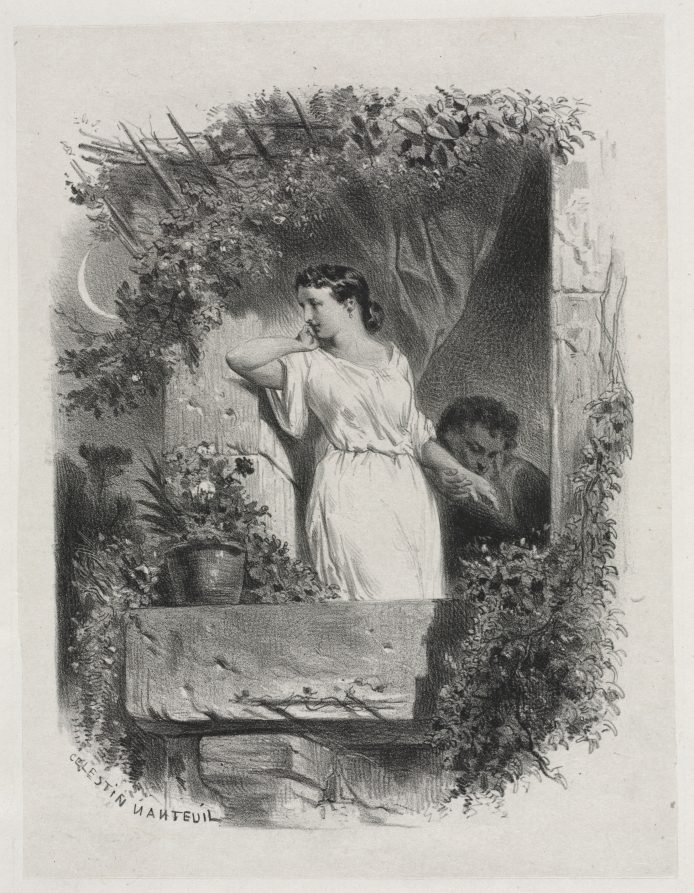
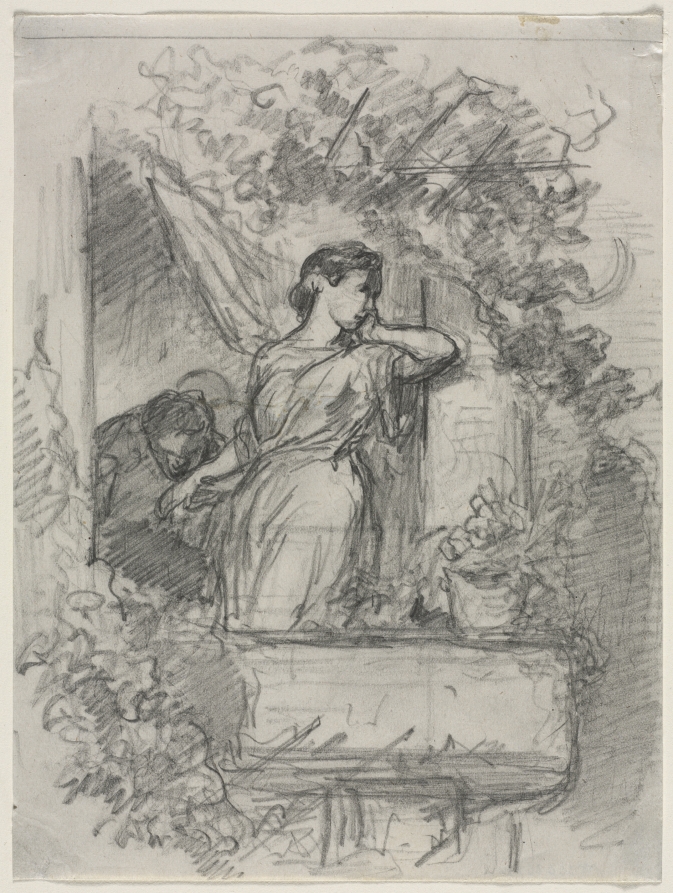
This drawing shows Célestin Nanteuil’s accomplishments as both a fine artist and illustrator. On one side, a couple converses, depicted in dense areas of ink—a practice Nanteuil learned from his friend, the author and artist Victor Hugo. Nanteuil scratched into these dark areas to create highlights. The back of the sheet features casually sketched vignettes, probably designed to accompany text in a book.
Provenance
Shepherd Gallery, New York, NY; Mr. Noah L. Butkin [1918-1980] (September 1975); Mrs. Muriel Butkin [1915-2008] (1980-2005); the Cleveland Museum of Art, Cleveland, OH (December 3, 2018)
Accession Number
2018.1064
Medium
pen and brown ink, watercolor and scoring (recto), pen and brown ink (verso) on medium weight wove paper
Dimensions
Sheet: 25.8 x 19.8 cm (10 3/16 x 7 13/16 in.)
Classification
Drawing
Credit Line
Bequest of Muriel Butkin
Tags
Drawing Neoclassical & Romantic (1751–1850) Watercolor Ink Paper French Color: Brown
Background & Context
Background Story
Celestin Francois Nanteuil's Seated Man and Woman, created circa 1830-1860, is a work by one of the most versatile and accomplished figures in the French Romantic art world. Nanteuil (1813-1873) was a painter, lithographer, and illustrator who played a significant role in the development of Romantic printmaking in France. As the official lithographer of the Musee Francois at Compiegne and a frequent exhibitor at the Paris Salon, Nanteuil moved in the circles of the leading Romantic artists of his generation, including Delacroix, with whom he collaborated on illustrations. Seated Man and Woman presents an intimate dual portrait or genre scene, reflecting the period's fascination with the nuances of human relationship and social interaction. Nanteuil's facility with both painting and printmaking lent his compositions a particular graphic quality: strong outlines, expressive poses, and a clarity of form that reflects his training in the reproductive print arts. The dating of this work to the broad period of 1830-1860 encompasses some of the most turbulent and transformative decades in French history, from the July Revolution of 1830 through the rise and fall of the Second Republic to the establishment of the Second Empire under Napoleon III. Whether the composition is a formal double portrait or a genre scene of domestic intimacy, it reflects the Romantic era's interest in capturing the emotional dynamics between individuals. Nanteuil's versatility as an artist allowed him to work across media and genres with equal accomplishment, and this work likely benefits from the draftsmanship and compositional sense honed through his extensive career in printmaking.
Cultural Impact
Nanteuil's contribution to French Romantic printmaking was significant, as he helped establish lithography as a major artistic medium in France. His work as both a painter and printmaker exemplifies the productive interplay between the fine and graphic arts during the Romantic period.
Why It Matters
This work reflects the versatility of a French Romantic artist who moved fluidly between painting and printmaking, contributing to the era's rich visual culture through multiple media.